The short answer
A water damage inspection maps where water went, how wet each material is, and what class and category the loss is, so that a drying plan can be written and later proved complete. A standalone one indicatively runs $200 to $600 per published 2026 price guides, and is frequently waived or credited when the same firm does the mitigation. The report matters more than the visit: with no baseline reading on unaffected material there is no defensible definition of dry.
Key takeaways
- The deliverable is the report, not the visit. A verbal opinion and a lump-sum estimate is not an inspection.
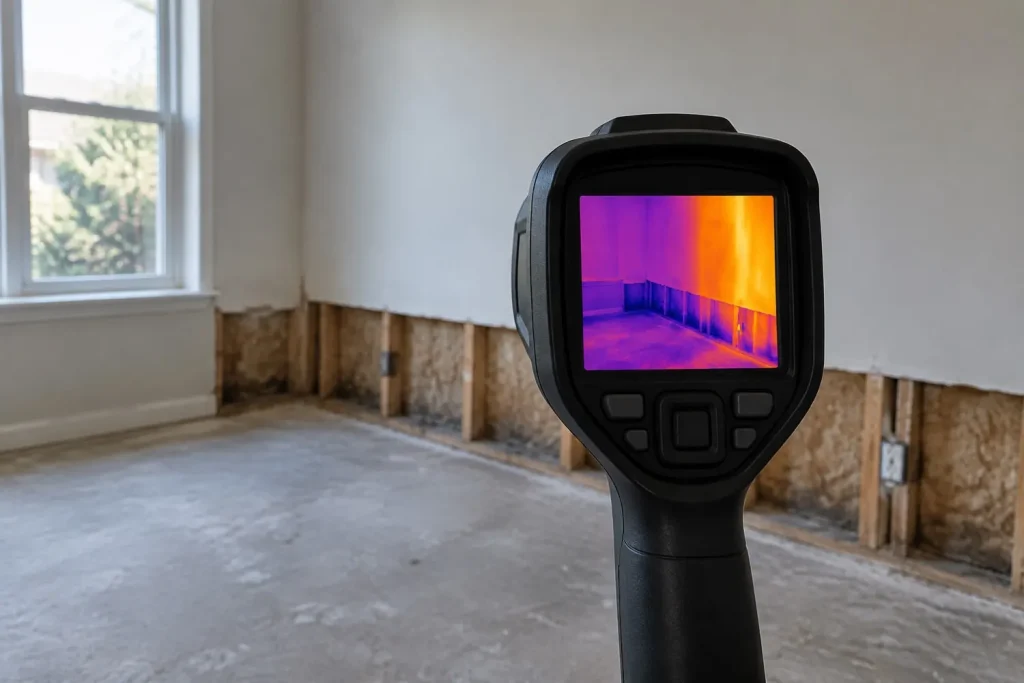
- A thermal camera detects temperature difference, not moisture. Wet areas often read cooler because of evaporative cooling, which is an inference that a moisture meter then has to confirm.
- A baseline reading on unaffected material of the same type in the same building makes dry a measurable target rather than an opinion.
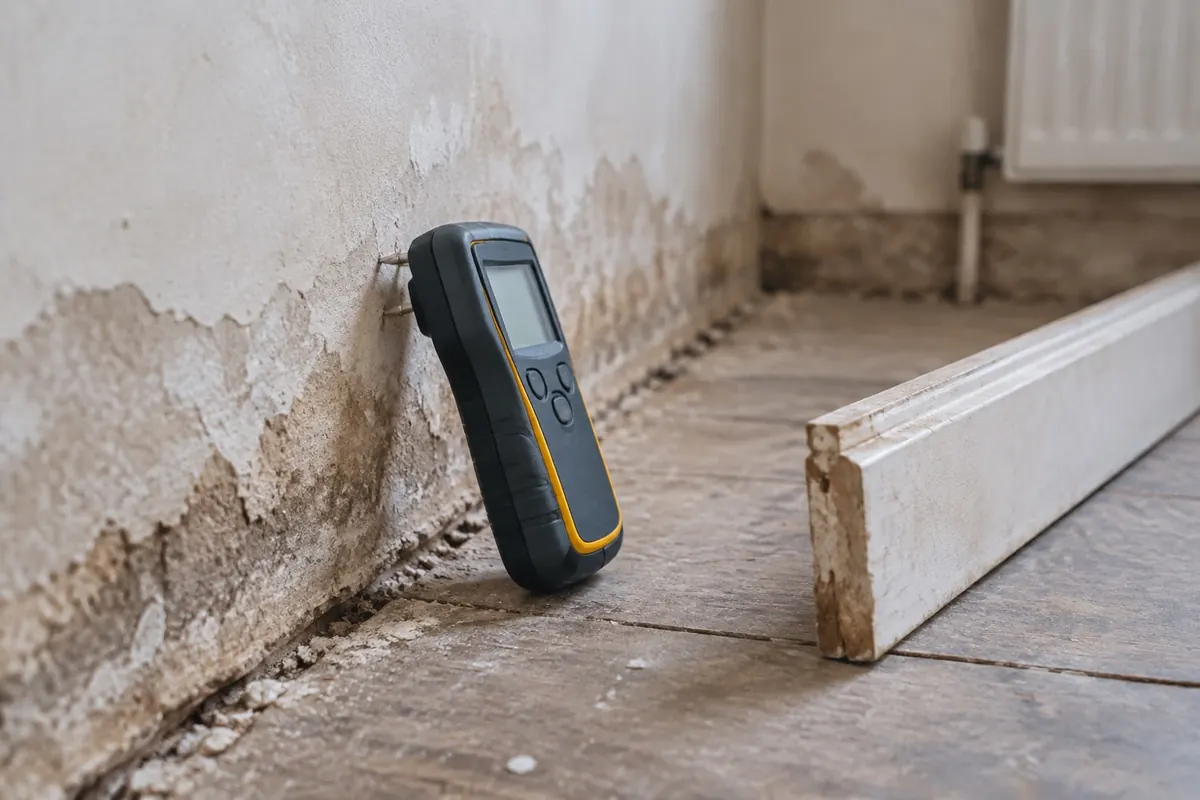
- Pin meters give an exact point reading and leave holes. Pinless meters scan non-destructively and are skewed by what sits behind the surface. Competent inspections use both.
- The report should state the IICRC category and class (ANSI/IICRC S500): those two values drive whether material dries or comes out, and how much equipment is justified.
- A free inspection from the firm that wants the mitigation work is a sales visit with instruments. It can still be a good one, but the incentive should be visible to you.
On this page
- What the inspection is for
- What it costs, and the free-inspection conflict
- The instrument set, and what each one does
- Thermal imaging measures temperature, not water
- The dry standard needs a baseline
- How a competent inspection runs
- What the report must contain
- Red flags in a bad report
- Where water hides
- Monitoring is part of the inspection
- How the report is used on a claim
- Questions to ask on site
- Questions people actually ask
A water damage inspection is the only part of a restoration job that produces evidence rather than work. The equipment count, the demolition scope, the invoice and the argument with an adjuster all rest on what was measured on the first visit and whether it was written down properly. This page covers the instruments, what each can and cannot tell you, and the contents of a report you can rely on.
What the inspection is for
Four questions have to be answered before any equipment is set. The inspection exists to answer them.
| Question | Why it has to be answered first |
|---|---|
| Where did the water go? | Water travels along framing, under flooring and into cavities. Drying only the visible area leaves moisture behind a wall, which later becomes a mould claim. |
| What category is it? | Contamination decides whether porous material dries in place or comes out. That is a demolition decision, not a billing one. |
| What class is it? | How much material is wet and how hard it resists drying sets the equipment count and duration. |
| What does dry mean here? | Without a target taken from unaffected material of the same type, there is no test for whether the job finished. |
An inspection is not an estimate
These arrive together and do different jobs. The inspection records conditions: readings, locations, photographs, category, class. The estimate prices a scope derived from them. A document jumping straight to a price with no readings behind it has skipped the justification, which is why scope disputes happen later. Our guide to Xactimate pricing covers how the estimate side is built once the conditions are known.
What it costs, and the free-inspection conflict
A standalone water damage inspection typically runs $200 to $600, depending on property size and whether a written report with photographs and a moisture map is included or charged separately. That range is indicative, compiled from published contractor and aggregator price guides current in 2026. Not a survey result and not a quote. Free and credited are different things: credited means billable if you decline to proceed, so ask which it is in writing before the visit.
The conflict is the same one mould inspections have
When the firm inspecting is the firm hoping to sell the drying work, the person deciding how much is wet is the person paid per day per dehumidifier. That is a structural incentive, not an accusation, and it has the same shape as the mould inspector who also sells remediation. Two defences: ask for the readings behind every affected area claimed, and on a large loss pay a firm that does no mitigation. Our mold inspection cost guide sets out the same conflict on the mould side.
The instrument set, and what each one does
Five instrument types cover almost every residential water loss. Each answers a different question, and none answers them all.
| Instrument | What it actually measures | What it is good for | Its limitation |
|---|---|---|---|
| Pin moisture meter | Electrical resistance between two probes driven into the material | An exact moisture reading at one point and depth, including deep inside a stud or hardwood plank | Leaves two small holes, and reads only where the pins are. |
| Pinless moisture meter | Change in a radio-frequency field just below the surface | Fast non-destructive scanning to find the wet zone and its boundary | Reads an averaged volume, not a point. Metal, wiring or foil-faced insulation behind the surface skews it. |
| Thermal imaging camera | Surface temperature, rendered as an image | Spotting anomalies fast across a wall or ceiling, which tells the operator where to put the meters | It does not detect moisture. A cool patch has several possible causes and must be confirmed with a meter. |
| Thermo-hygrometer | Air temperature and relative humidity, from which dew point and vapour pressure are derived | Judging whether the drying air can take up more vapour, indoors against outdoors against unaffected rooms | Says nothing about any material. It describes the air. |
| Borescope | Nothing. It is a camera on a probe | Looking inside a cavity, under a floor or behind cabinetry through a small hole before opening it up | Requires a hole, and shows only the line of sight. |
Pin against pinless is not a preference, it is a sequence
The competent pattern is pinless first, pin second. Scan pinless to find where the moisture is and where it stops, then drive pins at the boundary and the wettest point for defensible numbers at a known depth. Pinless alone gives a map with no confirmed values; pin alone means guessing where to drill and still missing the edge.
Thermal imaging measures temperature, not water
This is the most misunderstood point in the subject, and marketing misrepresents it constantly. A thermal camera renders surface temperature. It cannot see moisture, it cannot see through a wall, and the colourful image is not a moisture map.
It is useful anyway because of evaporative cooling. Water evaporating from a wet surface takes heat with it, so a wet patch reads cooler than the dry material beside it and the camera renders the difference. That is an inference, one step removed from what you care about, and a meter has to confirm it before it goes in a report.
The dry standard needs a baseline
Moisture readings mean little in isolation. Materials differ, and per the IICRC framework normal moisture content for oak flooring is not normal for gypsum board or a concrete slab. A reading of 14% means one thing in one material and another in the next.
The fix is comparison. Readings on the same material, in the same building, in an area the water never reached become the dry standard. Drying is finished when affected material returns to that value, not after a set number of days. Without a baseline there is no completion test, which cuts both ways: the owner cannot tell when to allow rebuilding, and the contractor cannot prove the work finished if mould appears later. Our guide to structural drying covers drying goals, dry standards and moisture maps in more detail.
| Reading type | Where it is taken | What it is for |
|---|---|---|
| Baseline, or dry standard | Unaffected material of the same type in the same building | Defines the target affected material must return to. |
| Affected material reading | Inside the wet zone, at several depths and points | Establishes how wet, and how far the water spread. |
| Boundary reading | Just outside the apparent wet edge, in several directions | Proves where the affected area stops, which adjusters question. |
| Ambient reading | Affected room, unaffected room, outdoors | Shows whether the air can take up more vapour, and whether the equipment is achieving anything. |
| Daily monitoring reading | The same marked points, same order, each visit | Produces the drying curve justifying each further equipment day. |
How a competent inspection runs
The order matters: each step tells the next where to look.
- Establish the source and the time. What failed, when, when it was found, and whether it is stopped. Elapsed time is what moves a clean loss toward a contaminated one.
- Photograph before touching anything, wide then close.
- Take ambient readings in the affected space, an unaffected space and outdoors, then take the baseline on each affected material type in an area the water did not reach.
- Scan for extent with thermal imaging and a pinless meter, working outward until readings match the baseline.
- Confirm with pin readings at the wettest points and at the boundary, recording depth alongside the value.
- Inspect cavities with a borescope where the scan suggests water went inside an assembly, then classify the category and class with the reasoning written down.
- Write the drying plan: equipment types and counts, placements, target readings, expected duration.
What the report must contain
This is the checklist to hold a report against. Anything missing is something you cannot verify later.
| Required element | What good looks like |
|---|---|
| Date and time of inspection | Both. Elapsed hours affect the category. |
| Cause and source of loss | The specific failed component and where it is. |
| IICRC category and class | Both stated, with a sentence of reasoning for each. |
| Affected areas and materials | Room by room, materials named, dimensions given, plus a sketch or moisture map. |
| Baseline readings | Per material type, with the unaffected location identified. |
| Affected and boundary readings | Values with locations, depths and instrument, at numbered points. |
| Ambient conditions | Temperature and relative humidity for affected areas, unaffected areas and outdoors. |
| Photographs | Dated, of each affected area and of readings being taken. |
| Drying plan with equipment count | Type and number of air movers, dehumidifiers and air scrubbers, with placements and the reasoning behind the count. |
| Expected timeline and target readings | The values that end the job, and the day drying should reach them. |
Red flags in a bad report
Five absences tell you the report will not hold up, and all are visible in a two-minute read.
- No category or class stated. Those two values decide the demolition scope and the equipment count, and everything else depends on them.
- No baseline readings. There is then no definition of dry in the document, so no way to establish the job finished or needed to run as long as it did.
- No justification for the equipment count. A number of dehumidifiers with no affected volume and no class behind it cannot be checked, and it is the line most often disputed.
- No photographs. Day-one conditions cannot be reconstructed, and once drying starts that evidence is gone.
- An estimate with no scope breakdown. A lump sum with no line items or unit counts cannot be compared to another bid.
Two further things are cheap to ask and expensive to discover later: whether the person who took the readings holds a current water restoration certification, and whether the report states what it excludes. Contents, specialty flooring, the plumbing repair and any clearance testing are commonly outside a mitigation scope, and a report silent on that leaves the owner assuming they are in.
Where water hides
Water follows gravity, then capillary action, then whatever path the building offers. These are the places a thorough inspection checks. Our guide to wet drywall covers the tests that decide whether a wall is dried in place or cut.
| Location | Why it gets missed | How it is found |
|---|---|---|
| Wall cavity behind intact drywall | The surface reads near normal while the cavity and bottom plate are saturated | Pin readings into the cavity through a small hole, plus a borescope before opening anything. |
| Under laminate, vinyl or engineered flooring | The covering is a vapour retarder, so the surface reads dry while the subfloor holds water | Lift a section at the edge, or read from below where accessible. |
| Inside insulation | Wet insulation looks unchanged from the face | Inspection openings, guided by thermal anomalies. |
| Under and behind cabinetry | Toe kicks and cabinet bases hide standing water and get treated as fixtures rather than affected material | Remove a toe kick, borescope the void, meter the base. |
| The bottom plate and sill | Water tracks along framing and pools at the lowest horizontal member, behind the finish | Pin readings at the base of the wall, from both sides. |
| Ceilings below the loss | A ceiling can be wet across a wide area and show only a small stain, or none | Scan the whole ceiling, working outward to the baseline. |
Monitoring is part of the inspection
The first visit is one reading in a series. Daily monitoring turns it into evidence, because one set of numbers proves only that material was wet on one day. A sequence proves the drying is working, or that it is not. When readings stop falling the equipment has stopped pulling water out of that assembly, usually because a vapour retarder is in the way, the assembly needs a specialty system injecting air into the cavity, the air cannot take up more vapour, or the material will not dry in place. A flat curve with no change of approach for four days documents its own problem, worth raising while the equipment is there.
How the report is used on a claim
The report is what an adjuster reads to decide whether the scope is reasonable. Three things get argued, and all three are won or lost in the readings.
- Affected area. How many square feet were genuinely wet, evidenced by boundary readings returning to baseline. This drives most of the invoice.
- Equipment and duration. Whether the count followed from class and volume, and whether each extra day rested on a monitoring reading rather than a schedule.
- Removal against drying. Whether porous material came out because the category required it or because removing is faster than drying. The report’s category statement answers that. Our water category reference sets out the classification, and our restoration cost guide covers what each scope actually costs.
Pricing disputes are separate from scope disputes and get conflated constantly. Scope is how many units of what; pricing is the rate per unit. The report settles the first and says nothing about the second. Our methodology states the standing rules we apply to every figure we publish.
Questions to ask on site
Six questions, asked while the inspector is still on site, change what ends up in the report.
- What category and class is this, and why? Ask for the reasoning, not just the letter and number.
- Where is the baseline and what did it read? If there is none, ask for one before the equipment is set.
- Can you show me the boundary readings? The edge of the affected area decides the size of the job.
- How many units for how many days, and on what basis? The count should follow from the class and the volume.
- Free, credited, or billable if I do not proceed? Get the answer in writing.
- What is excluded from this scope? Contents, specialty flooring, the plumbing repair and clearance testing commonly are.
Questions people actually ask
How much does a water damage inspection cost?
A standalone inspection with a written report typically runs $200 to $600, indicative, per published 2026 price guides. It is frequently waived or credited when the same firm does the mitigation, worth clarifying in writing first, because credited means billable if you decline to proceed.
Can a thermal camera detect moisture behind a wall?
No. It renders surface temperature. Wet areas often read cooler because evaporation removes heat, so the image shows where to look, but a cool patch can equally be missing insulation, a cold pipe or an air leak. Every anomaly needs a meter to confirm it.
What is a dry standard in a water damage inspection?
A target moisture value taken from unaffected material of the same type in the same building. Affected material is dry when it returns to that value. Without a baseline there is no measurable definition of dry and no way to prove the drying finished.
How long does a water damage inspection take?
A single affected room is commonly under an hour. A multi-room loss with cavity inspection and a moisture map takes longer, because scanning works outward until readings return to baseline in every direction rather than stopping at the visible damage.
Do I need an independent inspection, or is the contractor’s enough?
On a small, clearly bounded loss the contractor’s inspection is normally adequate, provided it contains baselines, boundary readings and an equipment justification. On a large loss, or where scope is already disputed, an inspection from a firm with no mitigation interest separates the assessment from the sale.
What does a water damage inspection report have to include?
Date and time, cause and source, IICRC category and class with reasoning, affected areas and materials with dimensions, baseline and affected readings at identified points, ambient conditions, photographs, and a drying plan with equipment count and timeline.
Why does the inspector want to drill holes in my wall?
Because a pin reading inside the cavity, or a borescope look into it, is the only way to establish whether the assembly is wet behind intact drywall. A small hole to confirm a dry cavity is cheaper than replacing a wall later because water sat inside a closed assembly.
Sources
- Institute of Inspection, Cleaning and Restoration Certification, ANSI/IICRC S500 Standard for Professional Water Damage Restoration, 5th edition, 2021. Category and class framework, and drying verification against unaffected material. The standard text is sold by IICRC; we describe the framework rather than reproduce it. Retrieved 23 September 2026.
- Instrument descriptions reflect the generally understood operating principles of resistance pin meters, radio-frequency pinless meters, thermal cameras, thermo-hygrometers and borescopes. No device was tested for this article and no model accuracy claims are compared.
- The $200 to $600 standalone inspection range is indicative, compiled from published contractor and aggregator price guides current in 2026. Not a survey result and not a quote. We have run no contractor pricing survey; when we do, its sample and method will be published with it.
- The report-content checklist and red-flag list reflect standard documentation practice for insured water losses. Carriers and firms impose additional requirements.