The short answer
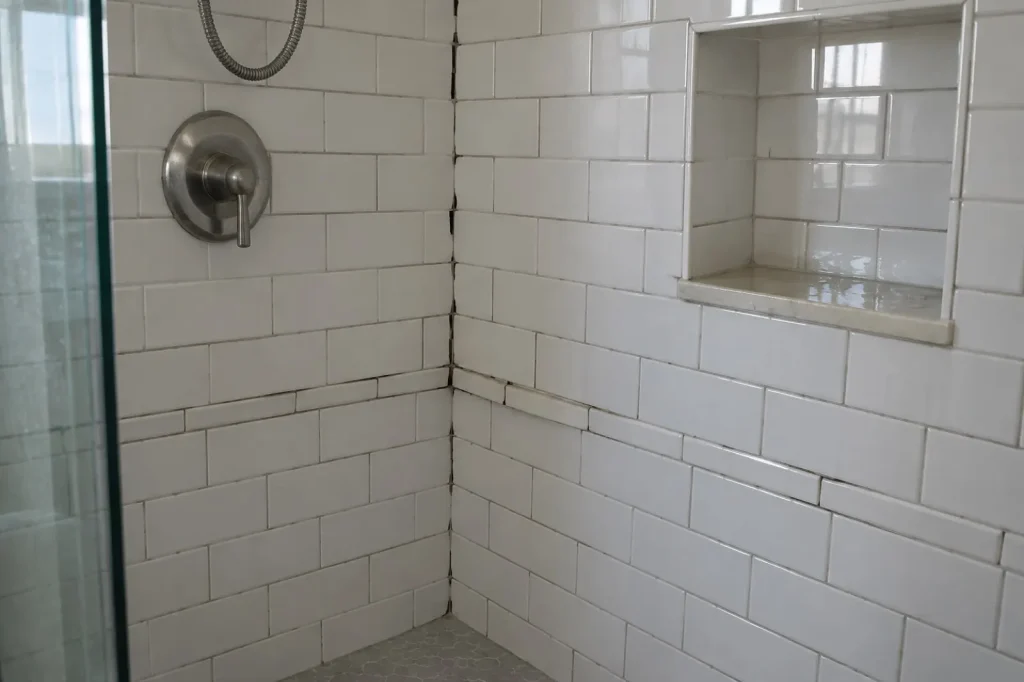
Water behind tile means water has passed the tile and grout and reached the setting bed, backer board or wall cavity. Tile and cement grout are not waterproof; the waterproofing is a membrane or pan liner behind them. Hollow tiles, white crust in the grout, grout that stays dark and damage on the far side of the wall are the signs; a meter and a flood test confirm it.
Key takeaways
- Grout joints are not waterproof, per the TCNA ceramic tile FAQ; the method and substrate behind the tile protect the wall.
- Leaks start at joints, not tiles: cracked grout, a failed corner seal, a flat niche sill or a clogged pan liner.
- A pinless meter reads about an inch deep on a comparative scale, according to the Tramex Moisture Encounter listing, and a thermal camera cannot see water at all, per the Teledyne FLIR leak detection guide.
- Regrouting fixes a joint, not a missing membrane. Soft backer or loose tiles across a wall mean a tear-out to the studs.
- The Philadelphia Code Bulletin B-0001 R1 calls green board not a waterproof material that deteriorates with repeated wetting.
On this page
Why tile and grout are not the waterproofing
The TCNA ceramic tile FAQ puts it in one line: grout joints are not waterproof, so in a shower you rely on the method and substrate to protect adjoining areas. The Schluter Shower System Installation Handbook goes further: contrary to popular belief, the tile covering itself is not waterproof, and moisture will get into the mortar bed and backing. Grout absorption limits under ANSI A118.6 are covered on our mold in shower page.
The waterproof layer is one of two things. A bonded membrane meeting ANSI A118.10, which the TCNA list of ANSI tile standards lists as the standard for load bearing, bonded, waterproof membranes for thin-set tile (2023 edition), sits directly under the tile. A traditional pan liner sits under a mortar bed and drains through weep holes. Either way, water behind shower tile is normal. Water past the waterproof layer is the failure.
What you are looking at: signs and look-alikes
Most signs have an innocent twin. Ask whether it returns, spreads or lines up with the shower.
| What you see | Look-alike | How to tell | Points to |
|---|---|---|---|
| White crust or fuzz in grout lines | Soap scum, hard water film | Efflorescence grows out of the joint and returns after cleaning | Water moving through the bed |
| Grout that stays dark hours after a shower | Wet grout after use | Normal grout lightens as it dries | Saturated bed behind it |
| Hollow sound when tapped | Large tile over a thin bed | Spreading, or tiles that move | Lost bond, often from water |
| Black line at corners or the tray joint | Surface mold on caulk | Gap or soft sealant under it | Failed change-of-plane joint |
| Stain, swelling or paint blisters on the far side | Condensation | Lines up with the shower valve or tray | Water in the cavity |
| Ceiling stain under the bathroom | Toilet or supply leak | Worsens after showers, not flushes | Pan or floor failure |
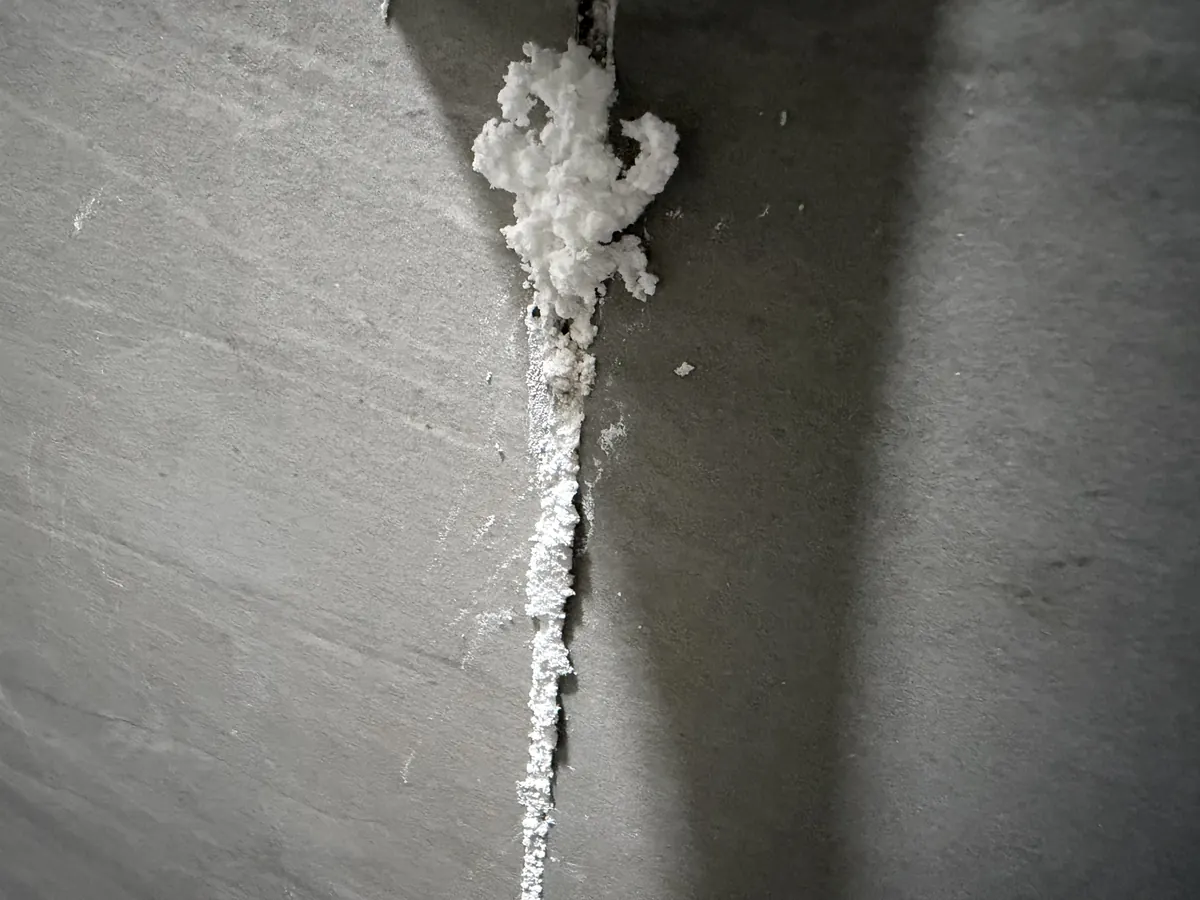

The Schluter Shower System Installation Handbook explains the white crust: in a traditional pan, the mortar bed can stay saturated if the pre-slope was skipped or the weep holes clog, raising the potential for efflorescence and mold. Hollow tiles matter because, according to the same handbook, the TCNA Handbook requires mounted tile to allow 95% contact with the setting material in wet areas.
Five failure points, and how each shows
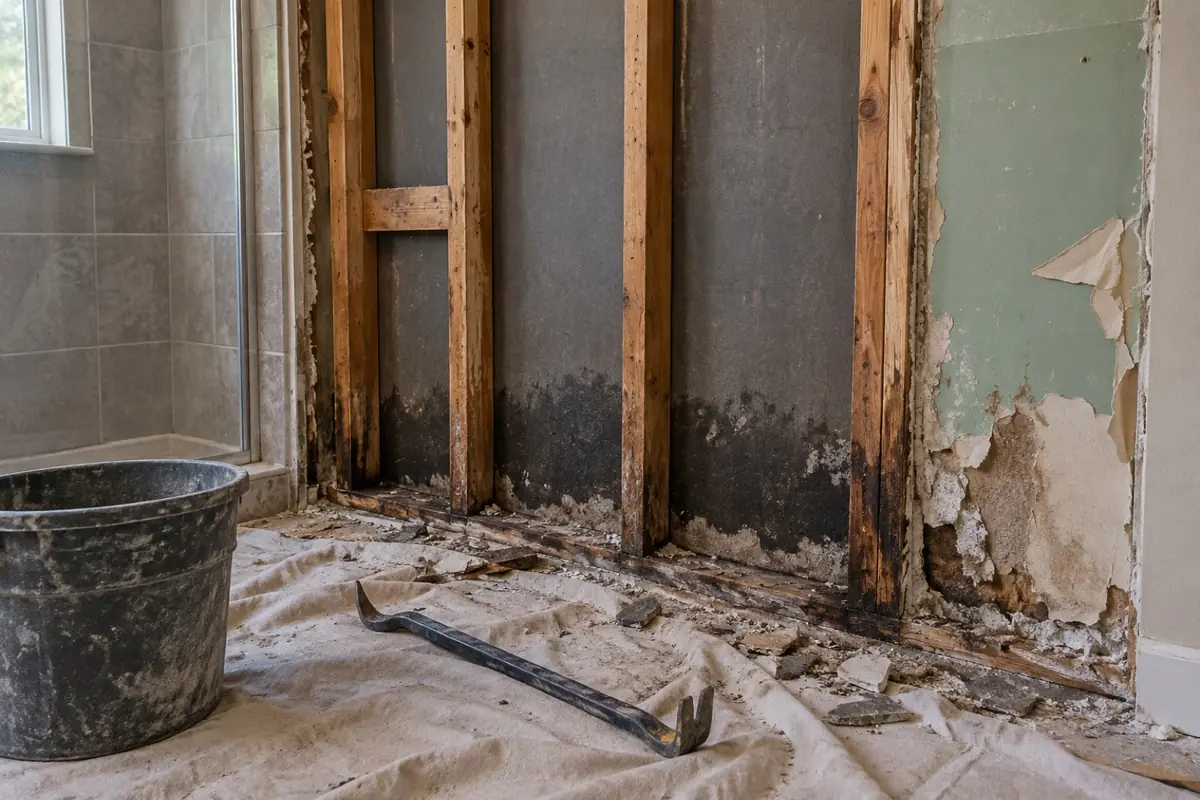
Failed shower waterproofing is rarely a tile problem. It is a joint, a slope or a missing layer, and each one has its own test and scope.
| Failure point | Sign | Test | Scope |
|---|---|---|---|
| No membrane | Far-side damage, soft board, loose tiles in the spray zone | Meter on the far side; inspection opening | Tear out to studs, rebuild with a membrane |
| Failed pan liner | Floor grout dark or crusted, stain below | Flood test the floor | Floor tile and bed out; pan rebuilt |
| Cracked grout | Visible cracks, dark lines | Meter compared with dry tile nearby | Regrout if tiles are sound and the bed dries |
| Failed change-of-plane joint | Gap or black line at corners, tray or tub | Spray the joint; meter below it | Cut out, reseal with sealant |
| Flat niche or bench | Water standing on the sill or seat; crust below | Watch it drain after a shower | Rebuild the niche or bench with slope |
No membrane at all
Tile on bare board relies on the board drying between showers. There is no repair from the tile side.
A failed shower pan liner
A traditional liner fails at the drain clamp, at the curb or where the weep holes clog. Pan repair is a plumbing job, covered by The Plumbing Brief; the water damage around it is covered here.
Grout leak
Over a working membrane, water through a cracked joint still reaches the drain. A grout leak that wets the far side means the layer behind has failed too.
The change of plane
The Custom Building Products grout sheet TDS-178 says grout is not for movement joints or changes of plane, where caulk or sealant is used, and the Laticrete Hydro Ban data sheet DS-663 requires expansion at coves, corners and other changes in plane.
Niches and benches
The Schluter Shower System Installation Handbook says all horizontal surfaces, including benches, curbs, window sills and shelves, must slope toward the drain. A level niche sill holds water against its joints after every shower.
Testing without demolition, and the limits
Meters read through tile, but shallowly. The Tramex Moisture Encounter listing gives about 1 inch of signal penetration through coverings including ceramic tile, on a 0 to 100 comparative scale for non-wood materials. Compare a suspect area with dry tile on the same wall; an absolute number means little. The Teledyne FLIR leak detection guide says a thermal camera cannot see moisture in walls, only temperature differences from evaporation, capacitance or conduction, and that a meter should always confirm it.
| Test | What it reads | Limit | Source |
|---|---|---|---|
| Pinless meter on the tile face | About 1 inch deep, comparative 0 to 100 scale | Not the cavity; relative only | Tramex listing |
| Meter on the far side of the wall | The drywall and cavity face | Only where the far side is accessible | Tramex listing |
| Thermal camera | Surface temperature | Cannot see moisture; needs confirming | FLIR |
| Flood test of the floor | The floor assembly and drain | Does not test the walls | Schluter FAQ |
| Spray test of one joint | That joint only | One suspect at a time | Method |
| Inspection opening | The cavity directly | Needs a patch | Definitive |
The flood test
The Schluter water test FAQ describes it: plug the waste line, fill the base to just below the drain’s bonding flange, mark the level and wait, with 24 hours typical. On a new shower it proves the membrane before tile. On an existing shower it tests the floor assembly only. New membranes need cure time first, and the published waits differ.
Three membranes compared, from their own data sheets
When a shower is opened, the membrane in it, or its absence, decides the rebuild. These three products are common in US showers; the figures are from each maker’s current sheet.
| Item | Custom RedGard | Laticrete Hydro Ban | Schluter KERDI-DS |
|---|---|---|---|
| Standard | ANSI A118.10 and A118.12 | Exceeds A118.10 and A118.12 | ANSI A118.10-SV |
| Form | Liquid, two coats | Liquid, two coats | Sheet, 20 mil |
| Cured thickness | 0.015 to 0.038 in | 20 to 30 mils | 20 mil |
| Vapor permeance | 0.35 perms at 30 mils | 1.247 perms | 0.19 perms |
| Before flood test | Both coats cured; 1 to 1.5 h a coat, up to 12 | 2 h at 70F; 24 h at 50 to 69F | 24 h |
| Plain drywall | Interior dry areas only | Gypsum wallboard listed | Handbook lists gypsum wallboard for KERDI |
Permeance matters for steam showers, not for ordinary leaks. The Laticrete Hydro Ban data sheet DS-663 says not to use it as a vapor barrier, especially in steam rooms, while the KERDI-DS sheet presents its 0.19 perms for continuous-use steam rooms.
Tile on cement board, drywall or greenboard
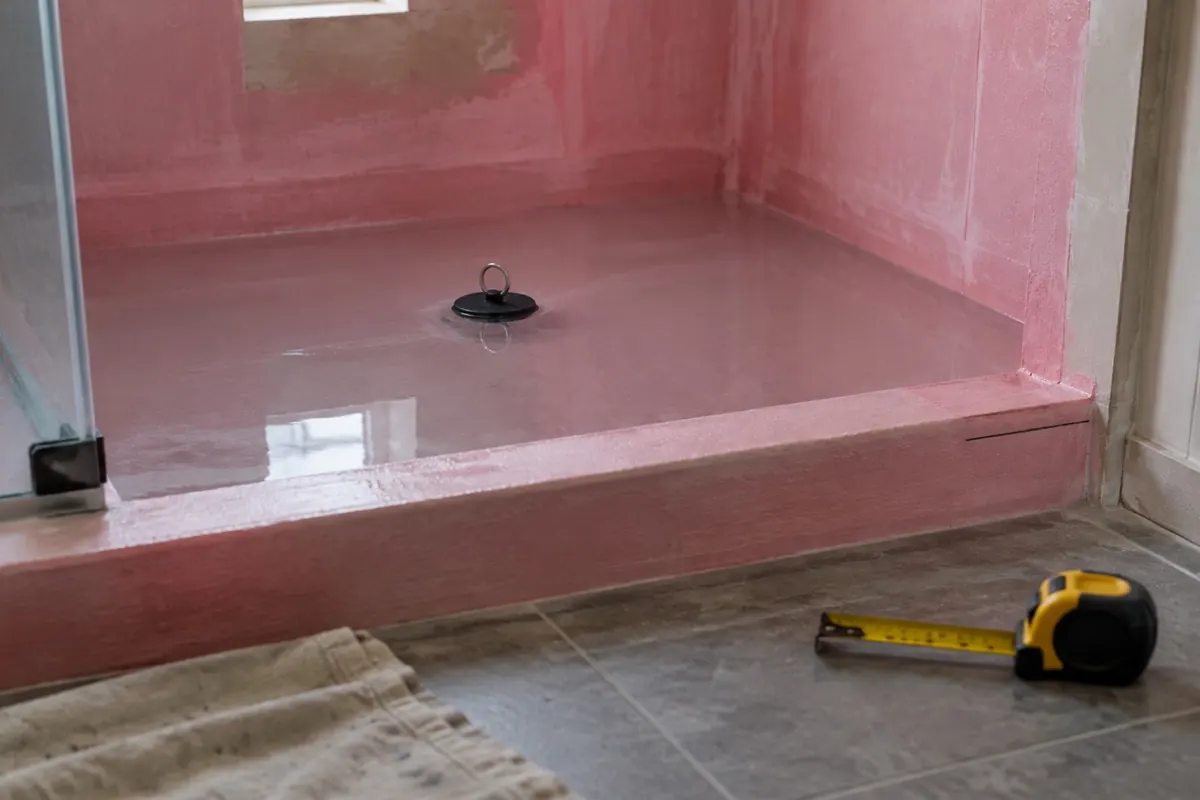
The Philadelphia Code Bulletin B-0001 R1 says paper-faced green board is not a waterproof material, will deteriorate if subjected to extended or repeated water, and must not be used in continuous high humidity. It quotes the city’s IBC-based section B-2509.2 requiring glass mat gypsum, fiber-cement or fiber-mat reinforced cement sheets as the base for wall tile in tub and shower areas. For houses, Walls and Ceilings magazine reported in August 2004 that from the 2006 IRC, paper-faced green board no longer met the standard as a wet-area tile backer, while ASTM C1178 glass mat board remained approved.
| Substrate | What the sources say | Behind wet tile |
|---|---|---|
| Cement or fiber-cement backer | A tile base for tub and shower areas under Philadelphia code B-2509.2 | Not waterproof; water passes to the cavity without a membrane |
| Glass mat gypsum (ASTM C1178) | Also listed in B-2509.2; stayed approved in the 2006 IRC, per Walls and Ceilings | Same: a backer, not a barrier |
| Green board, water-resistant gypsum | Not waterproof; deteriorates with extended or repeated water, per Philadelphia | No longer an approved wet-area tile backer from the 2006 IRC, per Walls and Ceilings |
| Plain drywall under a membrane | Manufacturer by manufacturer, per TCNA | RedGard: dry areas only; Hydro Ban and Schluter list it |
The TCNA showers FAQ says makers disagree on drywall under a membrane, calls the IBC somewhat ambiguous, and says to check with a local code official.
The ICC site refused automated reads, so the current IRC text was not opened; code statements here come from the Philadelphia bulletin and Walls and Ceilings. Confirm your adopted edition.
The repair scope: regrout or tear out to the studs
Work down the list and stop at the first yes.
- Backer soft, or tiles loose across a wall? Tear that wall out to the studs. A wet backer cannot be dried reliably behind tile.
- Floor grout crusted or dark, stain below? Flood test. A failure means floor tile, bed and pan; the pan is a plumbing job.
- Wet only at a corner, the tray or the tub joint? Cut out and reseal the joint with sealant, let it dry, re-read.
- Water standing in a niche or on a bench? Rebuild that element with slope.
- Cracked grout, sound tiles, readings fall back to dry? Regrout. It restores the joint; it does not add a missing membrane.
- Growth on the backer or framing once opened? It is now a mold scope as well.
According to This Old House, if the tiles themselves are damaged, retiling is the better option, and removing old tile adds a few hundred dollars. Two other cost guides refused our fetch, so this is a single published source, shown as printed.
| Job | Published range | According to |
|---|---|---|
| Regrout a shower | $600 to $2,500, about $1,500 average | This Old House, updated 5 June 2026 |
| Tile a shower | $1,800 to $5,000 | This Old House |
| Remove old tile, per sq ft | $2 to $5 | This Old House |
| Epoxy grout, per sq ft | $8 to $12 | This Old House |
Mold behind tile
The EPA mold and moisture guide lists the back side of drywall and the inside of walls around leaking pipes among places mold hides, and says to suspect hidden growth when a building smells moldy but nothing shows. A leaking shower wall fits both. Growth on the grout face is a cleaning question, on mold in shower; growth on the backer or studs is a removal question, and the size threshold is on DIY mold remediation. Drying an opened cavity is on water damage in walls, and the board on the far side on wet drywall.
Out of scope: this page does not cover health effects. For those, see EPA and CDC guidance.
Escalation triggers
- Damage on the far side of the wall or a ceiling stain below; see early ceiling signs.
- More than a few tiles hollow or moving.
- Efflorescence that returns after cleaning.
- A musty smell with nothing visible.
- Readings that stay high days after the shower was last used.
For contractors: scoping water behind tile
The scope turns on what is behind the tile, so record it when the first tile comes off. Duration is the coverage question. The Eighth Circuit, Croxdale v. Travelers (2026) quotes a policy form excluding constant or repeated seepage or leakage over 14 days or more, and a shower leak is often slow by nature. Describe what you find; coverage is for the policy, the insurer and the state insurance department. See homeowners insurance and water damage.
| Record | Why it matters |
|---|---|
| Meter readings, wet and dry reference | Shows extent beyond the visible joint |
| Flood test: fill level, duration, result | Separates floor from wall failure |
| What is behind the tile once opened | Membrane present or not drives the rebuild |
| Grout, sealant and slope condition | Cause, and whether it was long term |
| Far side and ceiling below | Collateral scope |
Questions people actually ask
How do I know if there is water behind my shower tile?
Look for grout that stays dark long after a shower, white crust in the joints, tiles that sound hollow or move, a gap at corners, and damage on the far side of the wall or the ceiling below. Confirm with a moisture meter compared against dry tile, then a flood test of the floor.
Can water leak through grout?
Yes. The Tile Council of North America says grout joints are not waterproof, and Schluter says the tile covering itself is not waterproof. Over a working membrane or pan liner that water drains away. A grout leak that wets the wall behind means the waterproof layer has failed too.
Will regrouting stop a shower leak?
Only if the leak was the grout and the layers behind are sound and drying. Regrouting restores the joint; it does not add a missing membrane or fix a failed pan. If the backer is soft or tiles are loose across a wall, the scope is a tear-out.
Can water behind tile dry out on its own?
Some can, over a membrane that drains to the weep holes or the drain. A saturated bed over a clogged pan or a board with no membrane does not dry between showers, and Schluter links that saturation to efflorescence and mold. Readings that stay high days after use mean it is not drying.
Is green board OK behind shower tile?
Not as the wet-area backer. Philadelphia’s code bulletin says it is not waterproof and deteriorates with repeated wetting, and Walls and Ceilings reported it lost wet-area tile backer approval from the 2006 IRC. Check the code edition your jurisdiction adopted.
How do you flood test a shower pan?
Plug the drain, fill the base to just below the drain flange, mark the water level and leave it, typically 24 hours according to Schluter. A falling level or water below means a leak. New membranes need their published cure time first: Laticrete gives 2 hours at 70F for Hydro Ban.
Sources
- TCNA ceramic tile FAQ, TCNA showers FAQ and TCNA list of ANSI tile standards, Tile Council of North America. Retrieved 30 October 2026.
- Schluter Shower System Installation Handbook, Schluter KERDI-DS data sheet (both April 2026) and Schluter water test FAQ, Schluter-Systems. Retrieved 30 October 2026.
- RedGard data sheet TDS-104 and Custom Building Products grout sheet TDS-178, Custom Building Products, both 22 March 2023. Retrieved 30 October 2026.
- Laticrete Hydro Ban data sheet DS-663, Laticrete International, DS-663-0821. Retrieved 30 October 2026.
- Philadelphia Code Bulletin B-0001 R1, Philadelphia Department of Licenses and Inspections, issued 2000, revised 2010. Retrieved 30 October 2026.
- Walls and Ceilings magazine, 1 August 2004, on the 2006 IRC tile backer change. Retrieved 30 October 2026.
- Tramex Moisture Encounter listing, Checkline (distributor). Retrieved 30 October 2026.
- Teledyne FLIR leak detection guide, Teledyne FLIR. Retrieved 30 October 2026.
- EPA mold and moisture guide, US EPA, updated 18 February 2026. Retrieved 30 October 2026.
- This Old House, cost to regrout a shower, updated 5 June 2026. Retrieved 30 October 2026.
- Eighth Circuit, Croxdale v. Travelers (2026), No. 25-2454. Retrieved 30 October 2026.
- No price or threshold here was estimated. See our methodology and the water damage hub.
Products, codes and prices change. Check the data sheet for the product on site and the code your jurisdiction adopted.