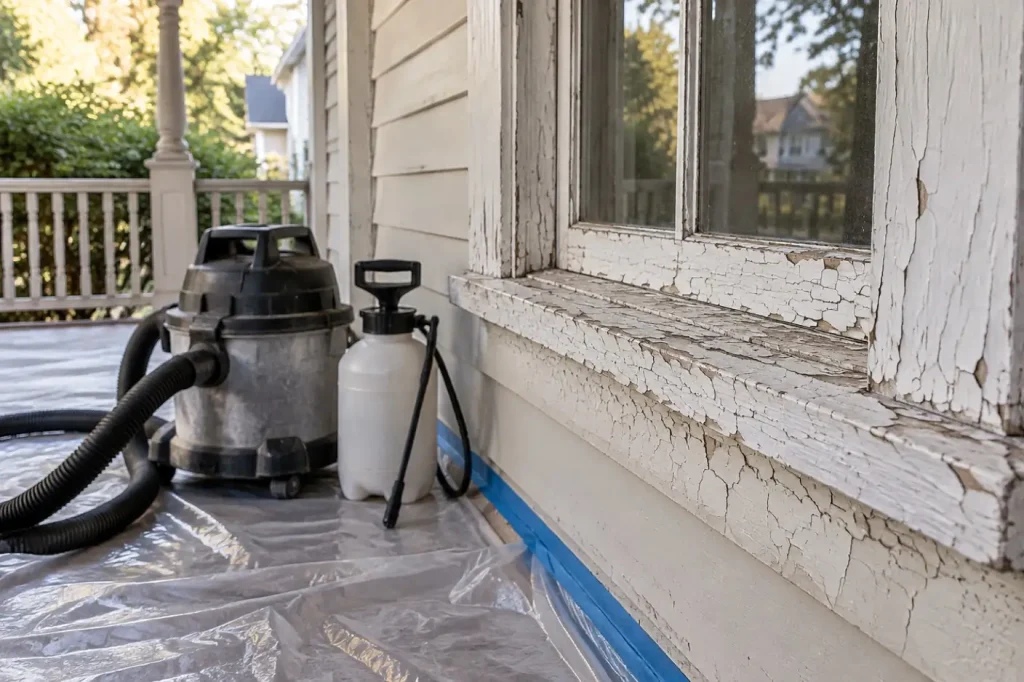
The short answer
Lead paint removal is regulated two different ways in a pre-1978 home. Paid work that disturbs paint is a renovation under the EPA RRP rule: a certified firm, containment and cleaning verification. Work designed to permanently eliminate lead hazards is abatement, done by certified abatement workers and cleared by dust testing. Owners working on their own home are outside RRP, but sellers and landlords must still disclose.
Key takeaways
- Intent sets the rule: per 40 CFR 745.223, abatement is work designed to permanently eliminate hazards.
- RRP starts above 6 sq ft of disturbed paint per room inside or 20 sq ft outside, per 40 CFR 745.83.
- Since 12 January 2026, any reportable level of lead in floor or sill dust is a dust-lead hazard, per 40 CFR 745.65.
- Abatement clearance tightened the same day to 5, 40 and 100 µg/ft² for floors, sills and troughs, per 40 CFR 745.227.
- EPA-recognized test kits are recognized only to show lead paint is absent, per the EPA lead test kit page.
On this page
Federal law treats removal as two jobs with different licences and finish lines; this page sorts yours first.
Out of scope. Health effects of lead are not covered here; start with EPA's Learn About Lead page. This page describes rules and published prices, not legal advice.
Lead paint removal: renovation or abatement
The line is purpose, not technique. Per 40 CFR 745.223, abatement is designed to permanently eliminate lead-based paint hazards; remodelling that incidentally reduces them is excluded. Per 40 CFR 745.83, any other work disturbing paint is renovation.
Both rules cover target housing: housing built before 1978, except elderly or disability housing and zero-bedroom units unless a child under 6 lives there. A child-occupied facility is a pre-1978 building visited by the same child under 6 at least two days a week, 3 hours a day, 6 hours a week and 60 hours a year, per 40 CFR 745.83. The lead line is 1.0 mg/cm² or 0.5% by weight, per the exemption test in 40 CFR 745.82.
| Work type | Which rule applies | Who may do it | Key threshold |
|---|---|---|---|
| Owner works on the home they live in | None under RRP, which covers paid work per 40 CFR 745.82 | The owner | EPA still recommends lead-safe practices |
| Paid work disturbing paint in pre-1978 housing or a child-occupied facility | RRP, Subpart E | EPA-certified firm with a certified renovator | Over 6 sq ft per room inside, 20 sq ft outside |
| Paid window replacement or demolition | RRP, Subpart E | Certified firm | No minimum area |
| Landlord repairs, in-home childcare, or a flip | RRP, Subpart E | Certified firm | Owner exemption lost, per the EPA RRP page |
| Contract to permanently eliminate hazards, or an abatement order | Abatement, Subpart L | Certified abatement firm and supervisor | EPA notice 5 business days ahead where EPA runs it |
| Emergency work after a flood, fire or burst pipe | RRP emergency provision | Any firm, for the emergency portion | Cleaning, verification and records still apply |
Which rule is your job under: a six-question path
- Built before 1978? If not, neither rule applies; if unknown, EPA says assume lead.
- Housing, childcare or preschool? Elderly or disability housing and zero-bedroom units are out unless a child under 6 lives there.
- Is anyone paid? An owner on their own home is outside RRP unless it is rented, hosts a childcare centre or is being flipped.
- Is the goal permanent elimination, or is there an abatement order? Then it is abatement, Subpart L.
- Over 6 sq ft per room inside or 20 sq ft outside, a window replacement, or demolition? Then it is an RRP renovation. Work in the same room within 30 days counts as one job.
- Has a certified inspector, risk assessor or renovator tested each affected component below 1.0 mg/cm²? With that record, RRP does not apply to those components.
Sources: 40 CFR 745.82, 40 CFR 745.83 and the EPA RRP programme page.
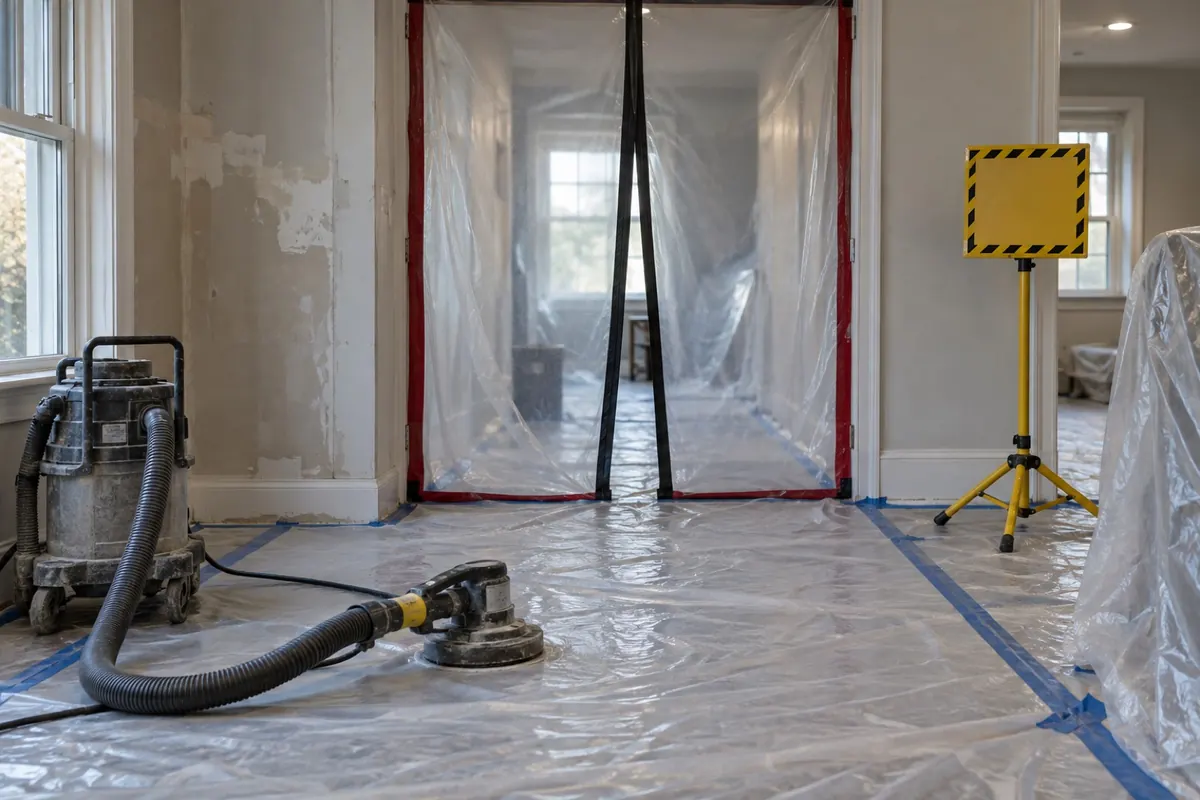
What you are looking at: lead hazard or just old paint
Old paint is not automatically a hazard. Per 40 CFR 745.65, a paint-lead hazard is one of four conditions, and each points at a location. That is why windows come first: a sash grinding in its channel turns paint into dust on the sill, which is where the regulation says to sample.
| Hazard type in 745.65(a) | Where it shows up | What makes it a hazard |
|---|---|---|
| Friction | Window sashes, jambs, doors, stair treads | Lead paint where dust on the surface below meets the hazard level |
| Impact | Door edges and frames | Paint damaged by a related component striking it |
| Chewable | Sills and rails at a child’s height | Lead paint with teeth marks |
| Deteriorated | Any surface | Peeling, chipping, chalking or cracking lead paint |
| Intact | Walls and trim in good condition | Usually not a problem, per EPA |
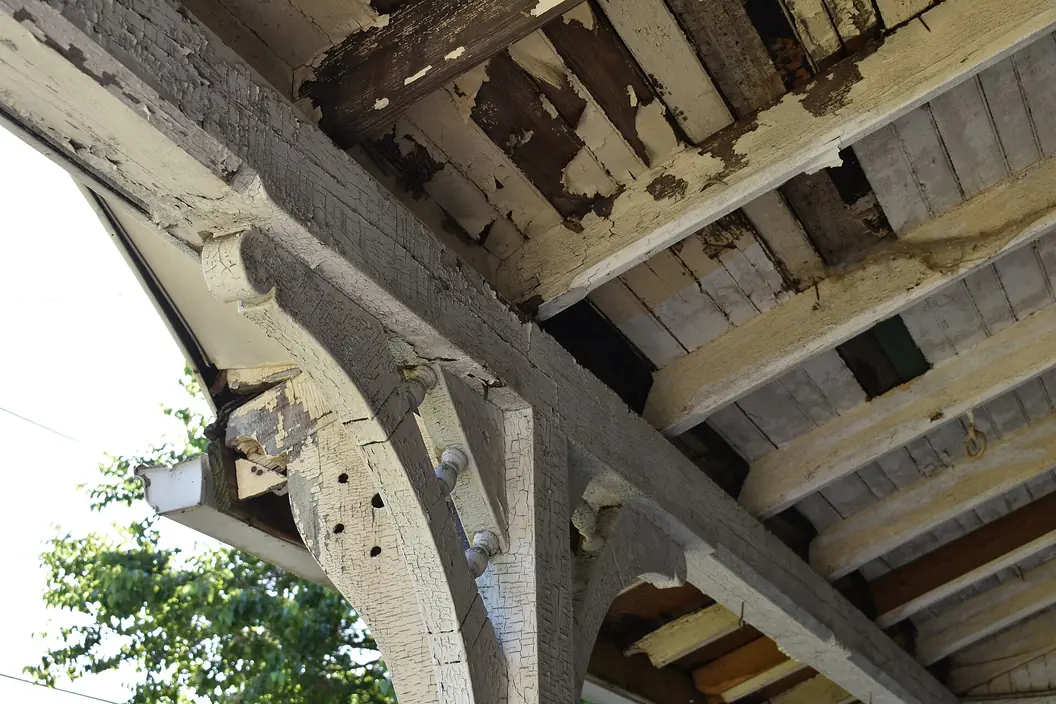
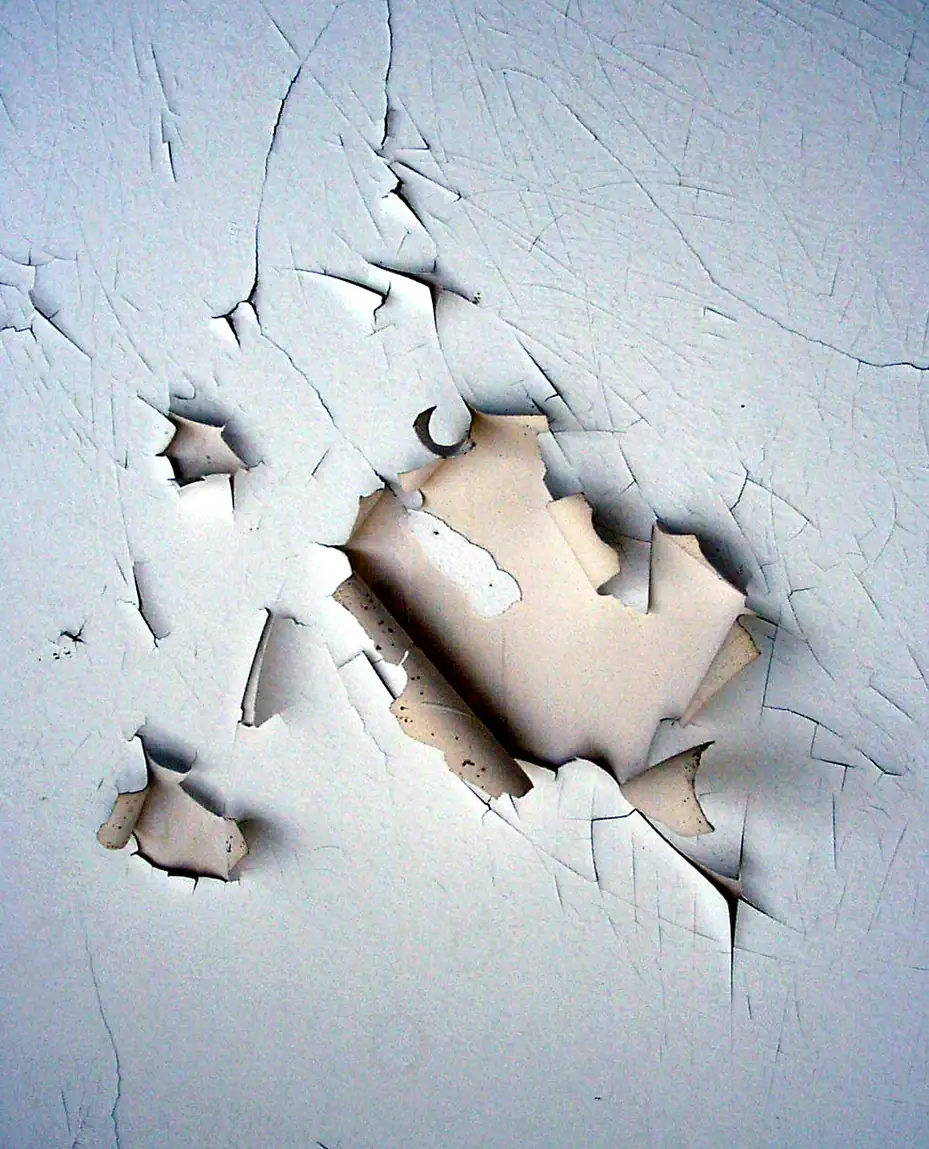
Alligatored porch paint looks the same with or without lead; EPA says the only way to know is to test. The photos below are described by their uploaders as lead paint, which a photo cannot prove.


How to tell if paint has lead
An inspection finds where lead paint is; a risk assessment finds whether hazards exist now, according to the EPA abatement programme page.
| Method | Who uses it for RRP | Recognized on | What a result can show |
|---|---|---|---|
| XRF reading in an inspection | Certified inspector or risk assessor | Every component with a distinct painting history | Lead under later coats; the report lists the XRF serial number |
| Paint chip to an EPA-recognized lab | Certified renovator or inspector | Each affected painted component | A number against 1.0 mg/cm² or 0.5% |
| LeadCheck (Luxfer Magtech) | Certified renovator | Wood, ferrous metal, drywall, plaster | Lead paint absent |
| D-Lead (ESCA Tech) | Certified renovator | Wood, ferrous metal, drywall, plaster | Lead paint absent |
| Massachusetts kit | Trained professional | Drywall and plaster only | Lead paint absent |
The kit limit is what most guides miss. Per 40 CFR 745.88, a kit may give a false negative on regulated paint 5% of the time or less; no kit has met the second test, false positives of 10% or less, EPA reports. A negative clears a component. A positive means treat it as lead or send a chip to a lab.
The January 2026 dust-lead numbers
EPA’s October 2024 rule, described on the EPA hazard standards page, split one number into two from 12 January 2026. Per 40 CFR 745.65, the dust-lead hazard was 10 µg/ft² on floors and 100 µg/ft² on interior sills; now it is any reportable level in a wipe sample analysed by an NLLAP-recognized lab.
The second number ends an abatement. Per 40 CFR 745.227, dust samples are taken at least 1 hour after final cleanup; any at or above the action level means re-clean and retest, and results between the two levels require a written dust-lead hazard statement in the abatement report.
| Surface | Action level before 12 Jan 2026 (µg/ft²) | From 12 Jan 2026 (µg/ft²) |
|---|---|---|
| Floors | 10 | 5 |
| Interior window sills | 100 | 40 |
| Window troughs | 400 | 100 |
The four lead paint abatement methods
Per 40 CFR 745.223, abatement includes paint removal, permanent enclosure or encapsulation, and replacing painted surfaces or fixtures. Regular paint over a hazard is not abatement, per the EPA abatement programme page. Fixr calls enclosure not permanent; the regulation lists permanent enclosure as abatement, and it is permanent while it stays intact.
| Method | Regulatory meaning | Where the lead ends up | Published price |
|---|---|---|---|
| Encapsulation | Coating or bonded covering forming a barrier | Stays; report notes any monitoring | $1 to $4 per sq ft, Fixr reports |
| Enclosure | Rigid materials mechanically fastened over it | Stays behind the barrier | $6 to $12 per sq ft, Fixr reports |
| Component replacement | Replace painted doors, windows, trim | Leaves the building | $1,000 to $15,000 per project, Fixr reports |
| Paint removal | Chemical stripping, scraping, heat gun below 1,100°F, or HEPA-exhausted machine | Leaves the surface; most dust | $8 to $17 per sq ft, Fixr reports |
Per 40 CFR 745.227, abatement adds duties RRP lacks: a certified supervisor on site for preparation and cleanup, a written occupant protection plan, dry scraping capped at 2 sq ft per room or 20 sq ft outside, and clearance only by a certified inspector or risk assessor.
The EPA RRP rule, step by step
This is the method in 40 CFR 745.85 for paid work in target housing. The firm needs EPA or authorized-state certification, renewed every 5 years per 40 CFR 745.89, and under 40 CFR 745.90 a certified renovator is on site while signs go up, containment is built and cleaning is done.
- Confirm or presume lead. Why this differs: A firm may skip testing and presume lead; clearing a component needs the record named in 745.82.
- Hand over the Renovate Right pamphlet and post signs. Why this differs: Signs stay until cleaning verification passes, not until the crew leaves.
- Contain the area. Why this differs: Floor sheeting 6 ft past the work inside, ducts sealed; ground cover 10 ft outside, openings within 20 ft closed. Generic dust control gives no distances.
- Use only permitted methods. Why this differs: Per the rule: no open flame, no heat gun at or above 1,100°F, no sander, grinder or blaster without a shroud and HEPA attachment. The usual DIY tools are the banned ones.
- Contain waste daily. Why this differs: Under containment each night, covered in transport.
- Clean high to low. Why this differs: Walls top down, HEPA vacuum with a beater bar on carpet, wet wipe, two-bucket or wet-system mopping.
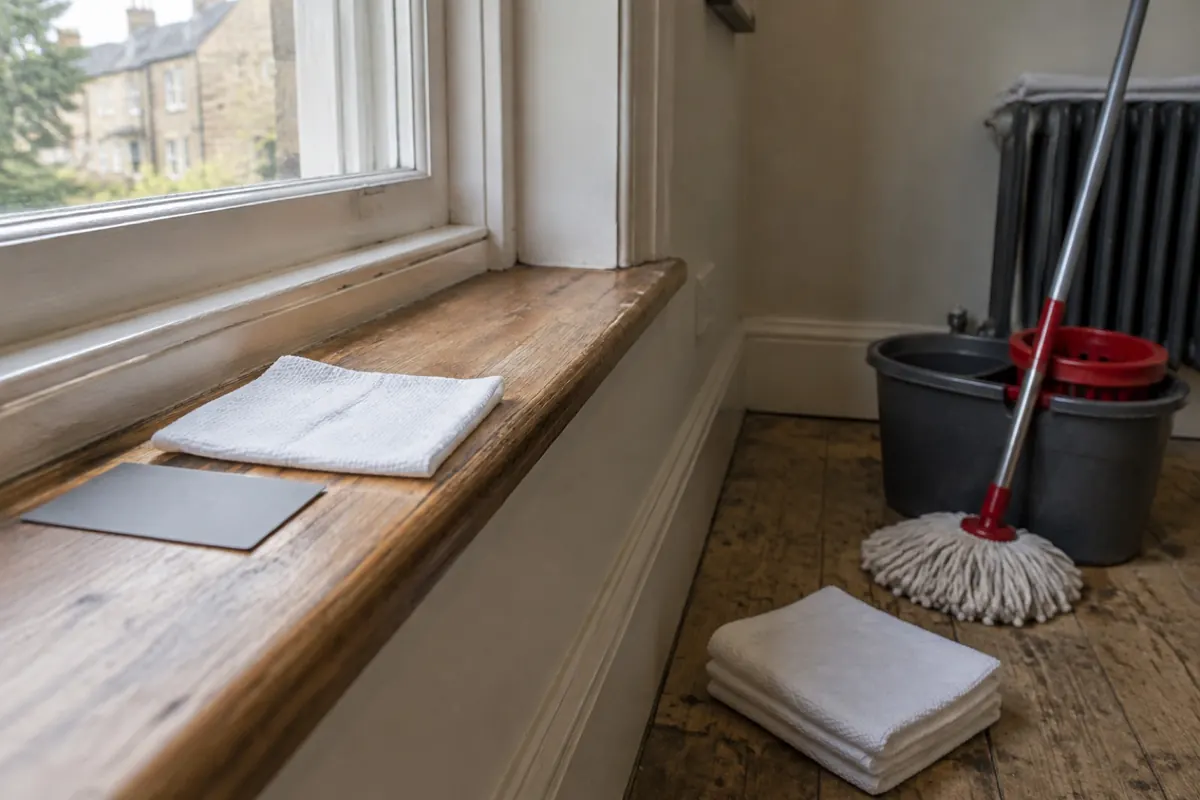
- Verify with cloths and the EPA card. Why this differs: Each sill and each floor section under 40 sq ft is wiped and compared with the card; a twice-failed area waits 1 hour for a dry cloth. No generic clean ends this way.
- Keep records 3 years. Why this differs: Per 40 CFR 745.86: training, test results, containment and cloth counts.
Per the definition in 40 CFR 745.83, a HEPA vacuum captures 0.3 micron particles at 99.97% efficiency, the filter class in air scrubbers.
Working on your own home
The EPA guidance for do-it-yourselfers says RRP generally does not apply to homeowners working on their own home, except when it is rented, hosts a childcare centre or is being flipped. HomeGuide tells readers that in most cases they cannot do it themselves; EPA says otherwise.
EPA still recommends a certified contractor, and lists for owners the toolkit firms must use: sheeting, a mister, wet-dry sandpaper, a HEPA vacuum, chemical strippers, a heat gun under 1,100°F and an N-100 respirator. EPA says most such waste is solid, non-hazardous waste, subject to local rules.
Selling or renting: the Section 1018 disclosure rule
Disclosure applies whether or not anything is removed. Per 40 CFR 745.107, before a buyer or tenant is bound, the seller or landlord hands over the pamphlet Protect Your Family From Lead in Your Home, discloses known lead paint or hazards and provides records. Buyers get 10 days for an inspection unless they waive it in writing, per 40 CFR 745.110.
It creates no duty to test or remove. Foreclosures and leases of 100 days or less are exempt per 40 CFR 745.101; the EPA real estate disclosure page says keep signed forms three years.
Who runs the programme in your state
The two programmes are authorized separately.
| Programme | Default administrator | States named by EPA |
|---|---|---|
| Renovation (RRP) | EPA, except authorized states | Alabama, Delaware, Georgia, Iowa, Kansas, Massachusetts, Mississippi, North Carolina, Oklahoma, Oregon, Rhode Island, Utah, Vermont, Wisconsin |
| Abatement, inspection, risk assessment | Authorized states, except where EPA runs it | EPA runs it in Alaska, Arizona, Florida, Idaho, Montana, Nevada, New Mexico, New York, South Carolina, South Dakota, Wyoming |
What lead paint removal costs
Three national guides differ by a factor of five on a whole job, so the spread is shown, not averaged. Fixr and HomeGuide both report disposal at $3 to $5 per sq ft on top.
| Source and date | Whole job | Encapsulation / enclosure / removal per sq ft | Testing |
|---|---|---|---|
| Fixr, 31 Jan 2025 | Fixr reports $10,000 to $30,000 | $1 to $4 / $6 to $12 / $8 to $17 | Test $250 to $450 |
| HomeGuide, 23 Jun 2025 | HomeGuide reports $3,000 to $17,000 | $6 to $10 / $8 to $13 / $10 to $17 | Inspection $300 to $700 |
| Bob Vila, 28 Feb 2023 | Bob Vila reports $1,445 to $5,412 | $4 to $8 / $9 to $10 / $8 to $17 | Inspection $200 to $400 |
Escalation triggers: bigger than the flaking spot
- A child’s elevated blood lead result. Interim controls become emergency renovations under 40 CFR 745.82, and abatement notice is shortened under 40 CFR 745.227.
- Chips at the dripline. Bare soil over 400 ppm in a play area is a hazard of its own.
- Teeth marks on a sill or rail. A chewable surface hazard by definition.
- Dust on sills after paint work. Any reportable level is now a hazard, so the next step is a risk assessment.
- An abatement order. The job is abatement whatever the contract says.
- Suspect asbestos in the same wall. Survey it separately; see asbestos inspection.
For contractors: lead on a restoration job
Per the EPA post-disaster guidance, water or fire work immediately needed to protect property and health is exempt from training, signs, containment and waste rules to the extent of the emergency, but not from cleaning, cleaning verification or records; the rebuild is a full RRP job. Flood cuts and wet drywall removal on painted walls are renovation; flood damage restoration covers the drying scope.
Keep three things in the file: the renovator’s course certificates, which 40 CFR 745.90 requires at the work site; the 745.86 record with cloth counts; and worker exposure data, because 29 CFR 1926.62 sets an OSHA action level of 30 µg/m³ and a 50 µg/m³ limit over 8 hours. That file also supports the containment and cleaning line items. The 1978 date comes from 16 CFR Part 1303; the standards hub lists related rules.
Questions people actually ask
Can I remove lead paint myself?
In the home you own and live in, yes: EPA says the RRP rule generally does not apply to homeowners working on their own home. It does apply if the home is rented, hosts a childcare centre or is being renovated to sell, and EPA still recommends a certified contractor.
Is it safe to paint over lead paint?
Regular paint over a hazard is not abatement, EPA says, because it does not permanently address it. Encapsulation, a coating or bonded covering designed as a barrier, is an abatement method under 40 CFR 745.223. Intact paint is usually not a hazard.
How do you tell if paint has lead?
Not by looking. The recognized routes are an XRF inspection by a certified inspector, a paint chip sent to an EPA-recognized lab, or for renovators one of three EPA-recognized kits: LeadCheck, D-Lead or the Massachusetts kit. Kits are recognized to show lead is absent, not to confirm it.
What is the EPA RRP rule?
The Renovation, Repair and Painting rule, 40 CFR 745 Subpart E, requires anyone paid to disturb paint in pre-1978 housing or child-occupied facilities to use a certified firm and renovator, contain the area, verify cleaning with cloths and keep records 3 years. Jobs under 6 sq ft per room inside are exempt.
What is the difference between lead paint abatement and RRP?
Abatement is designed to permanently eliminate hazards and ends with dust clearance testing by a certified inspector or risk assessor, plus an occupant protection plan. RRP covers renovation that disturbs paint for other reasons and ends with cleaning verification by the renovator.
How much does lead paint removal cost?
Fixr reports $10,000 to $30,000 for a whole house, HomeGuide reports $3,000 to $17,000, and Bob Vila cites $1,445 to $5,412. Per the guides, removal runs $8 to $17 per sq ft in two of the three, encapsulation costs less, and disposal is often billed on top.
Does a landlord have to remove lead paint?
Not under the federal disclosure rule, which creates no duty to evaluate or reduce hazards. Landlords must disclose known lead paint and records before a lease, and paid repairs that disturb paint must follow RRP. State or local law, or an abatement order, can require more.
Sources
- 40 CFR 745.65, hazard definitions, via eCFR. Retrieved 30 October 2026.
- 40 CFR 745.82, 40 CFR 745.83, 40 CFR 745.85, 40 CFR 745.86, 40 CFR 745.88 and 40 CFR 745.89, the RRP rule, via eCFR. Retrieved 30 October 2026.
- 40 CFR 745.223 and 40 CFR 745.227, abatement definition, practices and action levels. Retrieved 30 October 2026.
- 40 CFR 745.101, 40 CFR 745.107 and 40 CFR 745.110, disclosure rule. Retrieved 30 October 2026.
- 29 CFR 1926.62, OSHA lead in construction. Retrieved 30 October 2026.
- 16 CFR Part 1303, CPSC lead paint ban. Retrieved 30 October 2026.
- EPA RRP programme page, EPA guidance for do-it-yourselfers and EPA post-disaster guidance, EPA. Retrieved 30 October 2026.
- EPA lead test kit page, EPA hazard standards page, EPA abatement programme page, EPA real estate disclosure page and EPA's Learn About Lead page, EPA. Retrieved 30 October 2026.
- Fixr (updated 31 January 2025), HomeGuide (23 June 2025) and Bob Vila (modified 28 February 2023) cost guides. Retrieved 30 October 2026.
- How we source: methodology.
Federal rules only; authorized states can be stricter. Confirm thresholds with your state lead programme or EPA’s National Lead Information Center.