The short answer
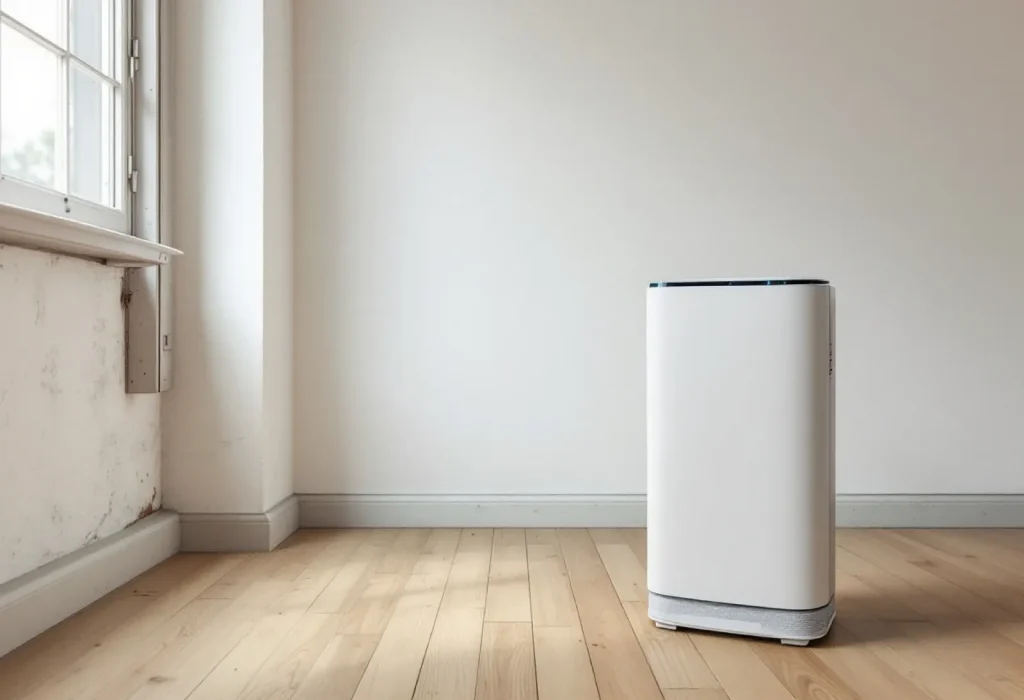
Yes, an air purifier for asbestos with a true HEPA filter traps fibres that pass through it, because HEPA means at least 99.97% capture at 0.3 micrometres, but it does not make a room safe. OSHA and EPA rules rely on wet methods, HEPA vacuums, sealed negative pressure enclosures and a clearance air test, and a room purifier replaces none of them.
On this page
Does a HEPA filter catch an asbestos fibre 0.25 micrometres wide?
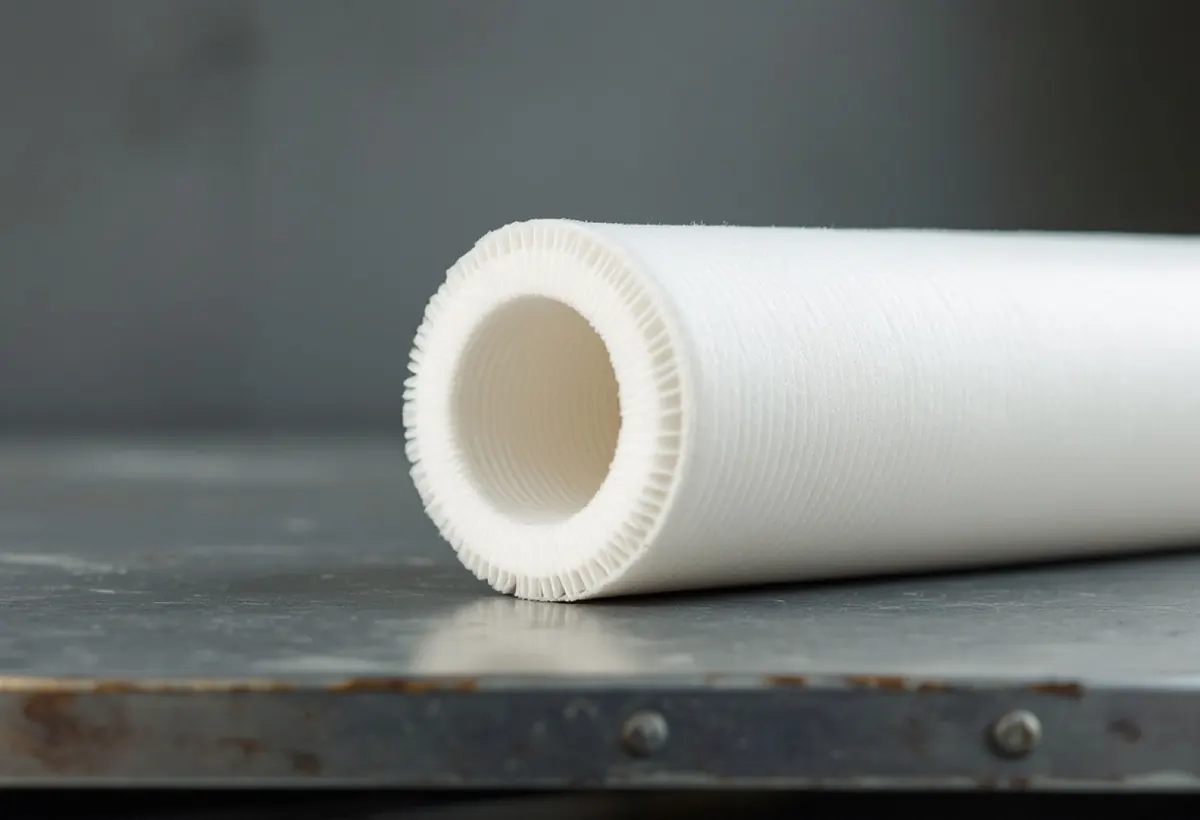
Yes, on paper. 29 CFR 1926.1101 defines a HEPA filter as one that traps at least 99.97% of mono-dispersed particles 0.3 micrometres in diameter, and EPA's HEPA definition page adds the physics: 0.3 micrometres is the most penetrating particle size, and particles larger or smaller are trapped with even higher efficiency. The definition traces to the U.S. Department of Energy, according to EPA.
Asbestos fibres sit on both sides of that test point. The OSHA rule counts a fibre only if it is 5 micrometres or longer with a length to diameter ratio of at least 3 to 1. NIOSH Method 7400, the light microscope count OSHA relies on, states that fibres thinner than about 0.25 micrometres will not be detected. The electron microscope method in the EPA school rule, 40 CFR Part 763, Subpart E, counts structures from 0.5 micrometres long with a 5 to 1 aspect ratio, which is why clearance tests use it.
Short particles dominate the reference samples. The ATSDR Toxicological Profile for Asbestos lists the share of particles longer than 5 micrometres in the international UICC reference samples at 3 to 6% for every commercial type it tabulates:
| Asbestos type (UICC reference sample) | Share of particles longer than 5 µm |
|---|---|
| Amosite | 6% |
| Chrysotile | 3 to 6% |
| Anthophyllite | 5% |
| Crocidolite | 3% |
So the filter is not the weak point. A fibre that reaches the media is very likely to stay there. The weak point is getting the fibre to the filter at all, which is the subject of every rule below. How long released fibres stay airborne before they settle is covered on our page on how long asbestos can stay in the air.
Where does a MERV 13 furnace filter fall short of HEPA on 0.3 to 1 micrometre particles?
A MERV 13 filter is rated to catch at least 50% of particles in the 0.30 to 1.0 micrometre band, per EPA's MERV table, which reproduces the ASHRAE test results. Per the same EPA page, a HEPA filter is held to 99.97% at the hardest size in that same band. That gap is the difference between a filter that halves fine particles on each pass and one that lets through 3 in 10,000 at worst, by EPA’s figures.
| Filter class | Minimum capture, 0.3 to 1 µm | Named in federal asbestos rules? |
|---|---|---|
| MERV 11 | 20% or more | Not HEPA |
| MERV 12 | 35% or more | Not HEPA |
| MERV 13 | 50% or more | Not HEPA |
| MERV 14 | 75% or more | Not HEPA |
| MERV 15 | 85% or more | Not HEPA |
| MERV 16 | 95% or more | Not HEPA |
| HEPA | 99.97% at 0.3 µm | Named in 1926.1101 and 40 CFR 763 |
EPA suggests MERV 13 or higher for home HVAC systems where the fan can handle it, which is general indoor air advice and not an asbestos control. Neither federal asbestos rule names any MERV class; both define equipment by the HEPA figure. Filters for furnaces belong to HVAC guidance, and HVAC filter choice is covered on our sister site thehvacbrief.com.
How many air changes does a 200 cfm purifier give a 600 square foot room?
About 2.5 per hour, before any losses. The EPA Guide to Air Cleaners in the Home publishes a sizing chart for particle removal that asks for a minimum clean air delivery rate (CADR) of 65 cfm for a 100 square foot room, rising in step to 390 cfm for 600 square feet, assuming an 8 foot ceiling. Converted to air changes per hour (ACH = CADR x 60 / room volume), every row of that chart works out to 4.9 ACH.
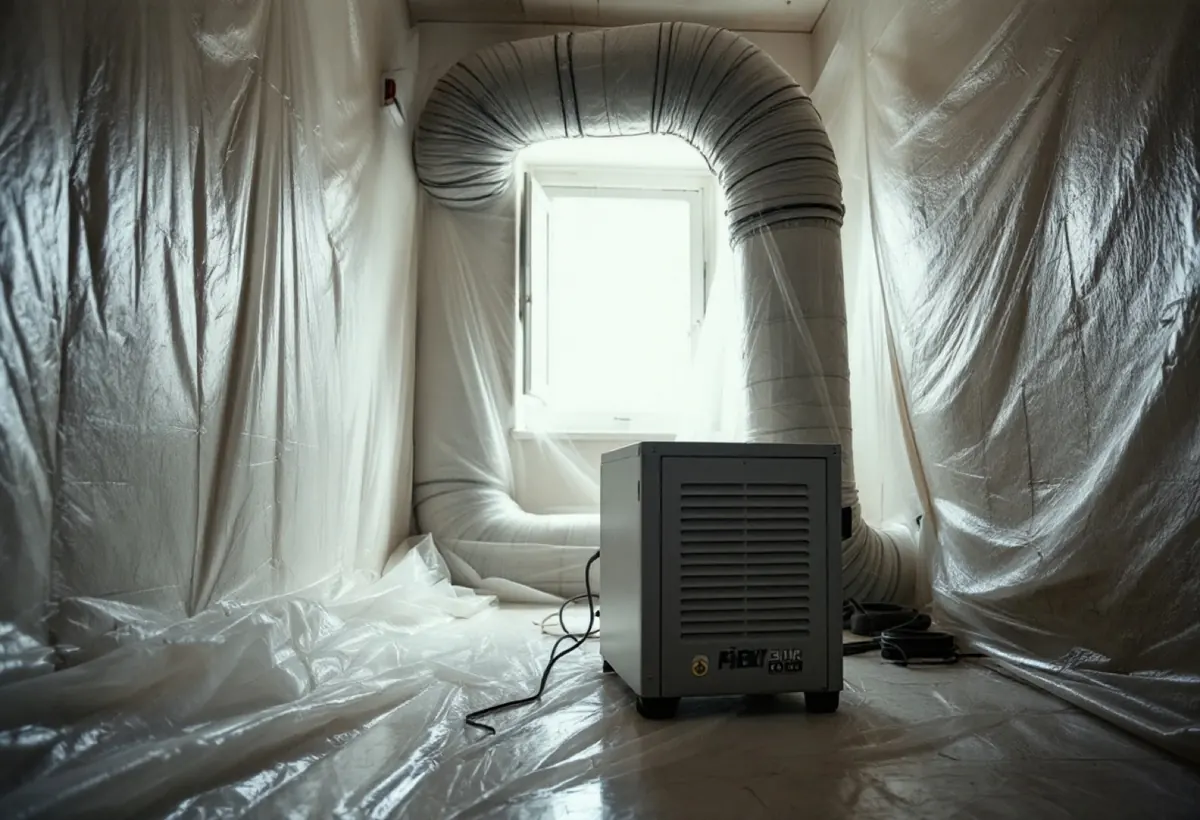
The OSHA rule asks for at least 4 air changes per hour inside a negative pressure enclosure under 1926.1101(g)(5)(i), so a correctly sized purifier moves a similar volume of air. The difference is direction. The enclosure also holds at least 0.02 inches of water below the surrounding space, so air leaks in, not out; a purifier recirculates and pushes nothing out of the room.
| Room area (8 ft ceiling) | Volume (cu ft) | EPA minimum CADR (cfm) | ACH at EPA minimum | ACH at 200 cfm | Ideal minutes to cut airborne count 99% at 200 cfm |
|---|---|---|---|---|---|
| 100 sq ft | 800 | 65 | 4.9 | 15.0 | 18 |
| 200 sq ft | 1,600 | 130 | 4.9 | 7.5 | 37 |
| 300 sq ft | 2,400 | 195 | 4.9 | 5.0 | 55 |
| 400 sq ft | 3,200 | 260 | 4.9 | 3.8 | 74 |
| 500 sq ft | 4,000 | 325 | 4.9 | 3.0 | 92 |
| 600 sq ft | 4,800 | 390 | 4.9 | 2.5 | 111 |
The last column is a best case and it is still informative: at EPA’s implied 4.9 ACH, a 99% cut takes about 57 minutes of ideal mixing, while a 200 cfm unit in a 100 square foot room gets there far faster at 15 ACH. The formula breaks the moment a source keeps releasing fibres, such as a crumbling pipe wrap or a ceiling being scraped, because the purifier is then cleaning air that is being refilled. Fibres that settle onto floors and shelves never reach it.
Why does OSHA require HEPA vacuums, wet methods and negative pressure, not room purifiers?
Because the rule controls the source. Under 29 CFR 1926.1101, paragraph (g)(1), every covered operation must use vacuum cleaners equipped with HEPA filters to collect asbestos debris, wet methods during handling, removal, cutting and cleanup, and prompt cleanup in leak tight containers, regardless of the measured exposure level. Paragraph (g)(3) bans dry sweeping, shoveling, compressed air blow off and abrasive saws without HEPA filtered exhaust.
The airborne limits are low. The permissible exposure limit is 0.1 fibre per cubic centimetre over 8 hours and 1.0 f/cc over 30 minutes, per 1926.1101(c). For Class I jobs where exposure is not shown to stay under that, paragraph (g)(4)(vi) requires ventilation that moves contaminated air away from workers toward a HEPA filtration or collection device. That is where an engineered air filtration unit sits on a job, ducted to the outside, not a purifier on a shelf.
| Question | Room HEPA purifier | Negative pressure HEPA unit under 1926.1101 |
|---|---|---|
| Air path | Recirculates room air | Exhausts out of the enclosure through HEPA |
| Pressure | None required | At least 0.02 in. of water below outside, (g)(5)(i) |
| Air changes | Set by CADR and room size | At least 4 per hour, (g)(5)(i) |
| Containment | None | Sealed plastic enclosure, HVAC sealed with double 6 mil plastic, (g)(4)(iii) |
| Settled fibres | Not addressed | Wet methods and HEPA vacuums, (g)(1)(i) and (ii) |
| Proof of result | None | Air monitoring and, in schools, TEM clearance |
The equipment side, including how negative air machines are sized and rented, is on our page explaining what an air scrubber is. Respiratory protection for the people doing the work is a separate OSHA requirement, covered on our respirator for asbestos removal page.
Who decides a room is clear: the purifier or a 70 structures per mm² air test?
The air test. In schools, 40 CFR 763.90(i) says a removal, encapsulation or enclosure job is complete only after a visual inspection and aggressive air sampling. Under the EPA rule, with five samples drawn at 1,199 litres or more on a 25 mm filter, or 2,799 litres on a 37 mm filter, the average must not exceed 70 structures per square millimetre by TEM. Jobs up to 160 square feet or 260 linear feet may instead pass on PCM at 0.01 f/cc for each of five samples.
Aggressive sampling means stirring settled dust back into the air before pumping, so a quiet room that only looks clean can still fail. A purifier never produces a number, and no federal rule accepts its run time as evidence. The sampling methods, costs and lab tiers sit on our asbestos air monitoring page.
Do ionizer and ozone purifiers do anything to asbestos fibres?
Not usefully. EPA's page on ionizers explains that ion generators charge particles so they stick to walls, floors, tabletops, draperies and occupants, and that abrasion can put them back into the air. For a mineral fibre, moving it from the air onto the sofa is not removal. EPA’s ozone generator page states that ozone does not remove particles from the air.
Nothing chemical destroys the fibre either: the ATSDR Toxicological Profile for Asbestos describes asbestos fibres as chemically inert or nearly so, noting they do not evaporate, dissolve or burn. On ozone output, the California Air Resources Board has required certification of portable air cleaners sold in California since 2010, with electronic units held to 0.050 parts per million, and EPA quotes the FDA limit of 0.05 ppm for medical devices. Ozone machines sold for odour work are covered on our ozone generator page.
What can a homeowner run a HEPA purifier for, and what should it never replace?
The EPA homeowner guidance sets the order of operations. Material in good condition that will not be disturbed should be left alone and does not need testing. Damaged material, or any remodel that will disturb it, calls for repair or removal by a trained and accredited professional. Its list of don’ts includes: do not dust, sweep or vacuum debris that may contain asbestos, and do not saw, sand, scrape or drill it.
- Reasonable: running a HEPA unit sized to EPA’s chart as general dust control in a home with intact, undisturbed material that EPA says can stay in place.
- Reasonable: running one in occupied rooms next to a sealed professional job, as an extra layer, never as the containment.
- Not a substitute: for a sealed enclosure with 4 or more air changes and negative pressure when material is being removed.
- Not a substitute: for wet wiping and a HEPA vacuum on settled debris, or for a clearance air test before rooms are reoccupied.
- Never: an ozone or ionizer unit, for the reasons EPA gives above.
Federal law does not require accreditation for people who inspect, repair or remove asbestos in detached single family homes, per EPA, though some states do. When hiring, ask three things: whether the work will be under negative pressure with HEPA exhaust, who takes the clearance samples and whether that firm is independent of the contractor, and which clearance figure the job must meet. The difference between intact and crumbling material is set out on our friable asbestos page, and more rules pages sit in the standards hub.
Out of scope: this page covers filtration and the rules that govern it, not health effects. For those, see the EPA, the National Institutes of Health or the CDC’s ATSDR asbestos pages.
Questions people actually ask
What type of air purifier is best for removing asbestos particles?
A mechanical filter unit whose filter meets the HEPA definition of at least 99.97% capture at 0.3 micrometres, with no ionizer or ozone stage, and a CADR at or above EPA’s sizing chart: 65 cfm per 100 square feet at an 8 foot ceiling. It is a supplement to containment and a clearance test, not a replacement for either.
What kills asbestos?
Nothing does, in the sense people mean. ATSDR describes asbestos fibres as chemically inert or nearly so: they do not evaporate, dissolve or burn. Ozone, UV light and sprays leave the fibre intact. Under OSHA 1926.1101 the fibre is wetted, collected with HEPA vacuums or wet wiping, and sealed in leak tight containers for disposal.
Is there such a thing as a HEPA certified air purifier?
Not from the federal government. EPA states it does not certify or register air cleaning devices. HEPA is a filter performance definition, 99.97% at 0.3 micrometres, traced by EPA to the Department of Energy. AHAM runs the AC-1 program that verifies CADR, and CARB certifies units sold in California for ozone emissions and electrical safety.
Should I use a regular vacuum or a rented HEPA vacuum on asbestos debris?
EPA tells homeowners not to dust, sweep or vacuum debris that may contain asbestos and to call an asbestos professional if the material is from a damaged area or a large area must be cleaned. OSHA requires HEPA vacuums on the job and says they must be emptied in a way that minimizes reentry of asbestos, under 1926.1101(l)(1).
Does an air purifier help if a small piece of asbestos ceiling falls?
Not as the first step. EPA’s school rule treats 3 square or linear feet or less of fallen friable material as a minor fiber release episode: saturate the debris with wet methods, clean the area, seal the debris in a leak tight container and repair the damaged spot, under 40 CFR 763.91(f). A purifier can run alongside, but it does nothing for debris on the floor.
Should the furnace run while asbestos is being removed?
On a Class I job, OSHA 1926.1101(g)(4)(iii) requires the HVAC system in the regulated area to be isolated by sealing it with a double layer of 6 mil plastic or equivalent. Ask the contractor in writing how supply and return vents will be sealed and when the system can be restarted after clearance.
Sources
- 29 CFR 1926.1101, Occupational Safety and Health Administration, asbestos standard for construction: HEPA and fiber definitions (b), PELs (c), methods of compliance (g), housekeeping (l), via eCFR. Retrieved 12 November 2026.
- 40 CFR Part 763, Subpart E, U.S. Environmental Protection Agency, AHERA school rule: 763.83 definitions, 763.91 operations and maintenance, and Appendix A TEM fiber definition, via eCFR. Retrieved 12 November 2026.
- 40 CFR 763.90(i), EPA, completion of response actions and clearance criteria, via eCFR. Retrieved 12 November 2026.
- EPA's HEPA definition page, EPA Indoor Air Quality, What is a HEPA filter? Retrieved 12 November 2026.
- EPA's MERV table, EPA Indoor Air Quality, What is a MERV rating? Retrieved 12 November 2026.
- EPA Guide to Air Cleaners in the Home, EPA, 2nd edition, 2018: portable air cleaner sizing chart. Retrieved 12 November 2026.
- EPA's page on ionizers, EPA Indoor Air Quality. Retrieved 12 November 2026.
- EPA's ozone generator page, EPA, Ozone Generators that are Sold as Air Cleaners. Retrieved 12 November 2026.
- EPA states it does not certify or register air cleaning devices: EPA Indoor Air Quality FAQ. Retrieved 12 November 2026.
- EPA homeowner guidance, EPA, Protect Your Family from Exposures to Asbestos. Retrieved 12 November 2026.
- California Air Resources Board, Air Cleaner Information for Consumers, California Air Resources Board. Retrieved 12 November 2026.
- NIOSH Method 7400, National Institute for Occupational Safety and Health, Asbestos and Other Fibers by PCM. Retrieved 12 November 2026.
- ATSDR Toxicological Profile for Asbestos, ATSDR, U.S. Department of Health and Human Services, Chapter 4, Table 4-2. Retrieved 12 November 2026.
- Air change and decay figures are arithmetic by Remediation Insider on EPA’s published sizing chart, computed when this page was built. Our methodology sets out the standing rules.
Rules differ by state and city, and many add their own asbestos licensing and clearance rules. Confirm the rule for the job address with the state asbestos program before work starts.