The short answer
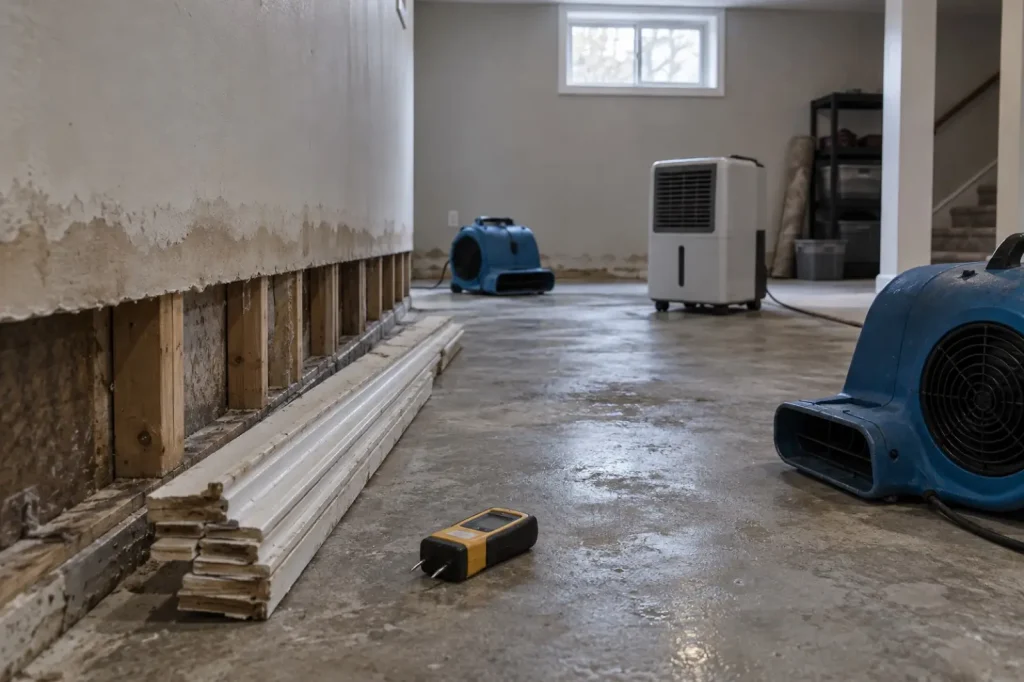
How long does it take for mold to grow after water damage? EPA and FEMA guidance says to dry wet materials within 24 to 48 hours, because past that window mold may start. The real clock depends on the material: according to published laboratory studies, paper-faced gypsum board grew mold within a week at 95% humidity, while cement board and glass fibre showed none in 12 weeks.
Key takeaways
- The 24 to 48 hour figure is a drying deadline, not a germination time. EPA’s commercial guide calls it only a guideline.
- Wet paper is the fast lane: in Danish lab work Stachybotrys was recognisable on soaked gypsum board after 5 days.
- Surface humidity sets the pace: per the ASHRAE 160 limit, keep 30-day average surface RH below 80%.
- Cold slows the clock: according to a Swedish 12-week test, gypsum boards at 10 degrees C grew nothing at up to 95% RH.
- Growth starts before anyone sees it: the first two stages of the building-science mold index are microscope-only.
On this page
Every page ranking for this question repeats the same line. This one shows where the number comes from, why a soaked ceiling tile and a damp slab behave nothing alike, and why a wall can be colonised before a stain appears, then turns it into a plan.
What this page does not cover: health effects of mold. For those, see the CDC and EPA mold pages and a medical professional. This page is about buildings and materials.
What 24 to 48 hours actually means
The figure is official. EPA's Brief Guide to Mold, Moisture and Your Home says materials dried within 24 to 48 hours after a leak usually will not grow mold, and FEMA's 2024 mold fact sheet tells flood victims to dry everything in the same window. Read the wording closely: every source frames it as a drying target, not a measured moment when spores sprout.
| Source | Exact wording |
|---|---|
| EPA, Brief Guide to Mold, Moisture and Your Home | “If wet or damp materials or areas are dried 24-48 hours after a leak or spill happens, in most cases mold will not grow.” |
| EPA, Mold Remediation in Schools and Commercial Buildings | “Note that mold growth will not always occur after 48 hours; this is only a guideline.” |
| FEMA, Prevent Mold from Becoming a Secondary Disaster (2024) | “Dry your home and everything in it as quickly as possible … within 24 to 48 hours if you can.” |
| FEMA, Mold: Problems and Solutions (2017) | “Items that cannot be properly cleaned and dried within 24-48 hours must be removed and thrown away” |
| ASHRAE position document (2012, reaffirmed 2018) | Repair leaks quickly and dry the water “within 24 to 48 hours.” |
That cuts both ways. A spill on a non-porous floor wiped dry may never grow anything, while the same EPA table says to remove wet ceiling tiles and cellulose insulation whatever the clock says.
Humidity, temperature and days
Fraunhofer Institute for Building Physics researchers put it plainly in Sedlbauer and Krus: temperature, humidity and substrate must all be present at once, for long enough, before mold forms. Moisture is the lead variable; the EPA Mold Course, Chapter 1 calls it the most important factor indoors. Loukou and colleagues (Journal of Fungi, 2024) report it as water activity (aw), where aw 0.80 equals an equilibrium relative humidity of 80%.
An isopleth joins every combination of temperature and humidity that gives the same germination time. Klaus Sedlbauer’s model, built from growth data for about 200 species found in buildings according to Sedlbauer, Zillig and Krus (2001), draws one set of lines per substrate group. Paper-faced gypsum board (Gipskarton) and wallpaper are Group I; renders, mineral materials, some woods and insulation are Group II; Group 0 is an optimal lab medium.
| Spores germinate within | Group 0 (optimal medium) | Group I (gypsum board, wallpaper) | Group II (render, mineral) |
|---|---|---|---|
| 1 day | 85% | 90% | 94% |
| 2 days | 80% | 85% | 89% |
| 4 days | 78% | 82% | 86% |
| 8 days | 75% | 80% | 84% |
| 16 days | 73% | 77% | 82% |
| Lowest limit (LIM) | 71% | 75% | 80% |
Per the chart, one day and sixteen days on gypsum board are only about 13 points of humidity apart: a wall at 77% RH is slow, not safe. Below the lowest line, the LIM, germination is ruled out. For changing conditions, each hour on the 4-day line adds 1/96 towards germination, per the authors.
Material by material
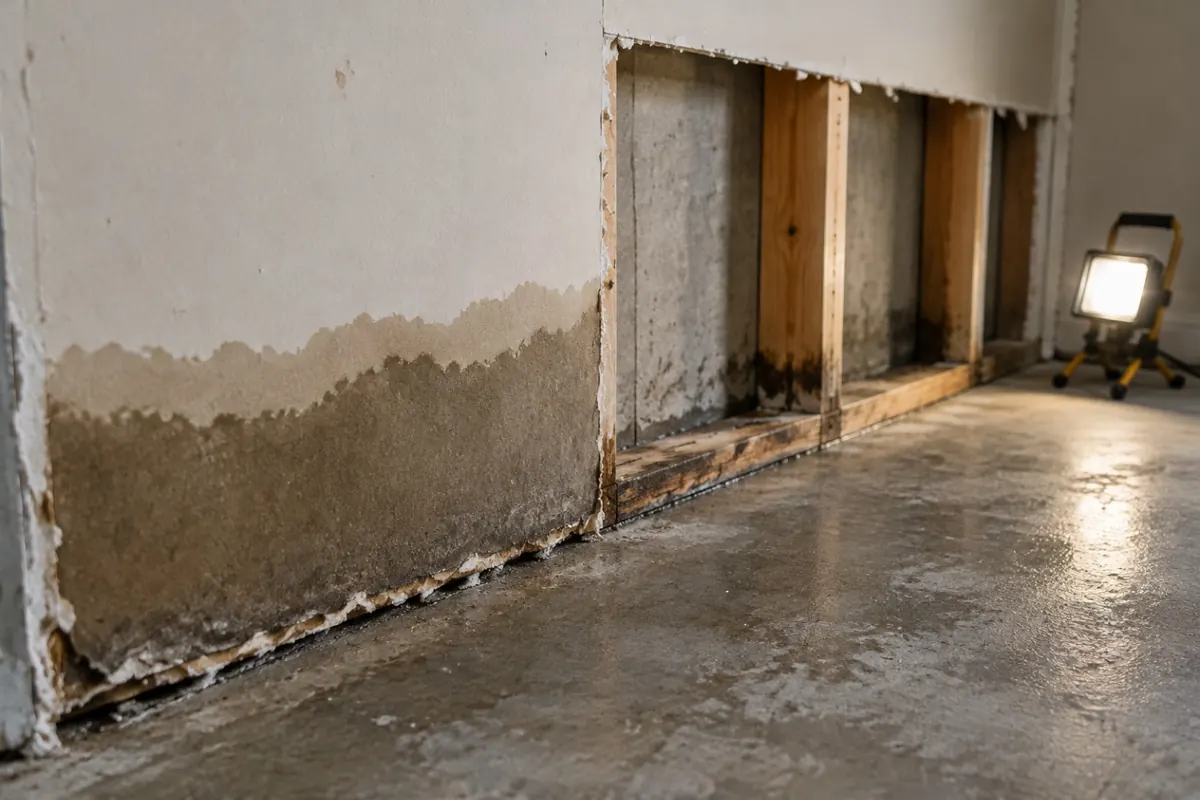
The most useful dataset comes from Sweden. Pernilla Johansson and colleagues inoculated 10 common building products with mold spores and held them at 75, 79, 85, 89 and 95% RH at 22 degrees C for 12 weeks, according to the 2012 paper reproduced in Johansson (Lund University, 2014).
| Material | Critical RH band, 22 C | Time to first growth | EPA Table 1 action if wet |
|---|---|---|---|
| Pine sapwood | 75 to 80% | 4 to 5 weeks | Wood: remove moisture, dehumidify, gentle heat |
| Plywood | 75 to 80% | 4 to 5 weeks | Wood: as above |
| Chipboard | 80 to 85% | 3 to 4 weeks | Not listed separately |
| Thin hardboard | 85 to 89% | 3 to 4 weeks | Not listed separately |
| Exterior gypsum board | 89 to 95% | within 1 week | Wallboard: dry in place if intact |
| Wet-room gypsum board | 89 to 95% | 3 to 4 weeks | Wallboard: dry in place if intact |
| Cement board, glass fibre, XPS | Above 95% | No growth in 12 weeks | Concrete: extract, dehumidify |
Gypsum board needs more humidity than pine to start, yet once humidity was high enough exterior gypsum board crossed its threshold inside the first week. Wood is a slow, persistent food; paper facing is a fast one. Nielsen (Technical University of Denmark, 2001) reports the same split: minimum RH just below 80% for wood-based and starch-containing materials at room temperature, about 90% for gypsum board. Johansson’s literature review reports concrete at 90 to 95%.
Soaked is different from humid. In Nielsen’s experiments, Stachybotrys chartarum was recognisable after 5 days on new water-damaged gypsum board, and boards inoculated with other isolates were fully covered after 14 days, per the thesis. Concrete offers little food, but Sedlbauer treats any heavily soiled surface as Group I. Carpet is fast too: EPA says dry carpet and backing within 24 to 48 hours, and our wet carpet guide covers why the pad usually goes.
Temperature and cold walls
In Johansson’s test, gypsum boards that grew mold at 22 degrees C grew nothing at 10 degrees C at any humidity up to 95%, according to the thesis.
| Material and source | Room temperature (22 to 25 C) | Cool (5 to 10 C) |
|---|---|---|
| Gypsum boards (Johansson) | Growth in the 89 to 95% RH band | No growth at any RH tested, up to 95% |
| Pine sapwood (Johansson) | Critical band 75 to 80% | Critical band 85 to 90% |
| Gypsum board, Group I (Sedlbauer chart) | 1-day germination near 90% at 25 C | 1-day germination near 95% at 10 C |
| Wood-based materials (Nielsen) | Just below 80% | About 90% at 5 C |
Cold surfaces cut the other way indoors, because the humidity that counts is in the air film on the surface. The ASHRAE position document on mold and dampness reports an example: room air at 55% RH and 78 degrees F puts any surface below 66 degrees F over 80% RH. Lstiburek’s Building Science Corporation report RR-0203 flags surface RH of 70 percent or higher as where mold problems begin. EPA and FEMA advise indoor humidity below 60 percent.
The timeline, hours to weeks
Hours matter for soaked paper, days for humid surfaces, weeks for chronic damp.
According to Glass and colleagues (ASTM STP 1599, 2017), the 2009 ASHRAE Standard 160 adopted three criteria from the International Energy Agency Annex XIV report: 30-day surface RH below 80%, 7-day below 98% and 24-hour below 100%, each between 5 and 40 degrees C. Addendum a cut them to the 30-day rule, and the same authors report that it overpredicts mold against field observations. At the slow end, Sedlbauer and Krus modelled growth on kraft paper in a metal roof starting after about 30 days, matching the mold found there.
Why you see it late
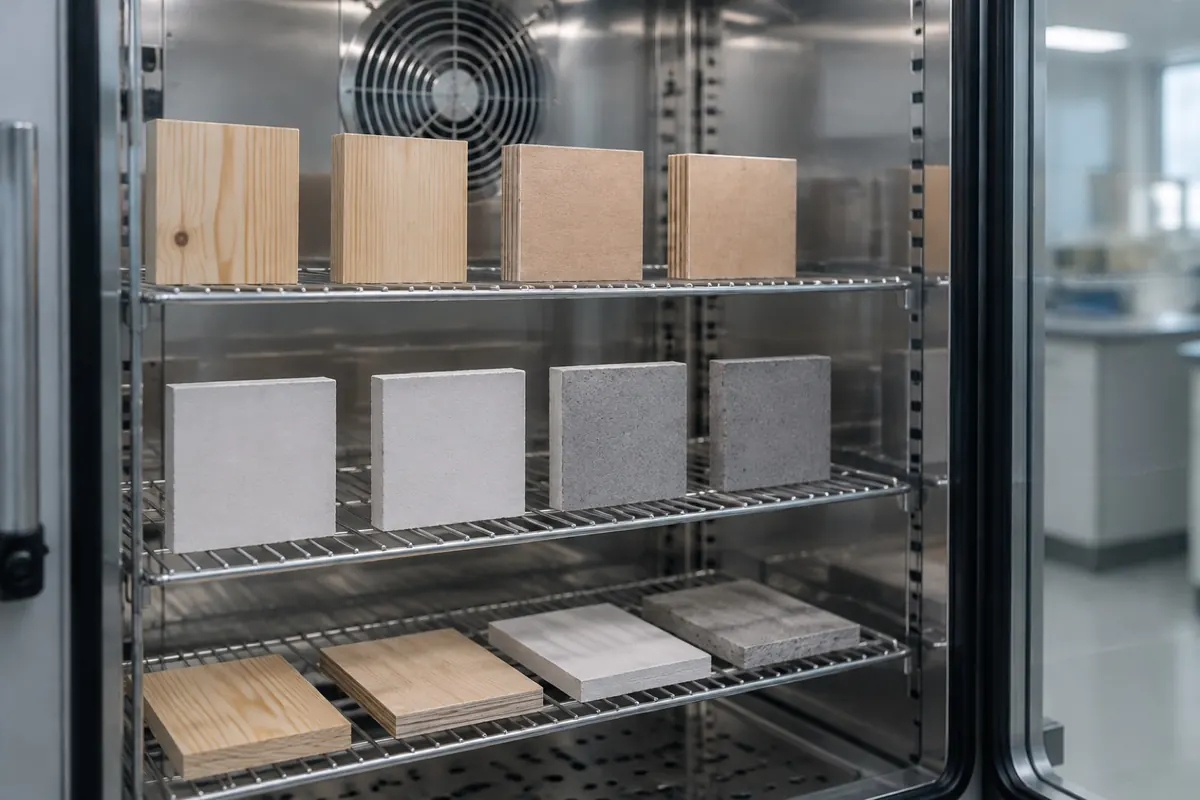
Germination is microscopic. The VTT mold index of Viitanen and Ojanen, tabulated in Glass and colleagues (ASTM STP 1599, 2017), makes the lag explicit: levels 1 and 2 show only under a microscope; visual findings begin at 3.
| Mold index | Growth stage | Under a microscope | To the naked eye |
|---|---|---|---|
| 0 | No growth; spores not activated | None | None |
| 1 | Initial stages of growth | Small amounts | None |
| 2 | Several local colonies | Several local colonies | None |
| 3 | New spores produced | Under 50% coverage | Under 10% coverage |
| 4 | Moderate growth | Over 50% coverage | 10% to 50% coverage |
| 5 | Plenty of growth | Not given | Over 50% coverage |
| 6 | Heavy and tight growth | Not given | About 100% coverage |
Johansson’s thesis reports many test pieces with extensive growth but no discolouration visible to the naked eye. Loukou and colleagues (Journal of Fungi, 2024) add that growth can be colourless, thin and patchy, or hidden in cavities. Because most studies define germination by first visible growth, as Sedlbauer notes, published times already run late. Moisture readings say more than looks.
What to do at each hour
The decision path to keep.
| When | Action | Why, and the source |
|---|---|---|
| Hour 0 to 1 | Stop the water; make power safe; photograph | Nothing dries while the source runs |
| Hours 1 to 24 | Extract water; pull pad and wet contents; start dehumidifiers and air movers; take baseline readings | EPA and FEMA: fans and dehumidifiers |
| Hours 24 to 48 | Remove what cannot dry in time: ceiling tiles, cellulose and fibreglass insulation | EPA Table 1: remove and replace |
| Hours 48 to 72 | Treat anything still wet as at risk; open cavities behind wet gypsum | EPA: wet over 48 hours, use Table 2 |
| Days 3 to 7 | Check hidden faces of board and framing; bag soaked porous material | Lab growth on soaked gypsum by day 5 |
| Week 2 onward | Scope it as a mold job by area | EPA Table 2: under 10, 10 to 100, over 100 sq ft |
| Ongoing | Indoor RH below 60%; cool surfaces under 80% | EPA, FEMA and ASHRAE guidance |
- Is the water still coming? Stop it first.
- Is the water clean? If it carried sewage or floodwater, porous materials go regardless of the clock; see our IICRC water categories page.
- Can it be dry inside 48 hours? If yes, dry it and confirm with a meter. If no, remove porous items now.
- Paper-faced gypsum or ceiling tile? These fail fastest; our wet drywall page covers the cut line.
- Wood or concrete? Dry in place with dehumidification and heat, as EPA Table 1 lists, and confirm by readings.
- Past day 7 and still wet? Assume hidden growth, open the assembly and scope by area.
See also our drying time page.
For contractors
When a water claim becomes a mold claim, the questions are when the water started, when drying started and what was removed. Log it as you go; structural drying covers equipment and targets.
| Record this | Why a reviewer asks |
|---|---|
| Time of loss and of first response | The 48-hour window is checked first |
| Moisture readings by material and location | Shows what met the dry-in-time standard |
| Surface temperature and RH, not only room RH | The ASHRAE and isopleth limits refer to surfaces |
| Photos of removed porous items | FEMA asks for photos of discarded items |
| Affected area in square feet | EPA Table 2 sets containment by area |
Removing wet cellulose ceiling tile and insulation inside the window is defensible on EPA’s own Table 1. On a loss found late, scope it as remediation from the start; our mold remediation process page covers containment and clearance.
What the research cannot tell you
Every germination time here comes from steady chamber conditions. Real buildings swing hour to hour, and Loukou and colleagues (Journal of Fungi, 2024) note that growth under fluctuating condensation is much slower than after soaking in a flood. Nielsen called his 5-day result partly due to a high spore dose.
Treat the numbers as a ranking: paper before wood, wood before concrete, warm before cold, soaked before humid. They do not say a wall is safe at hour 47; opening it does. For species and colour, see black mold against regular mold; the mold hub lists every related guide.
Questions people actually ask
How likely is mold after water damage?
It depends on what got wet and for how long. EPA says materials dried within 24 to 48 hours usually will not grow mold. Paper-faced gypsum board and ceiling tiles fail fastest, while in Swedish lab tests cement board and glass fibre grew nothing in 12 weeks. Soaked paper in a warm room is the worst case.
How long does it take for mold to grow on wet drywall?
Paper-faced gypsum board is among the fastest. In Danish lab work, Stachybotrys was recognisable on soaked gypsum board after 5 days and boards were fully covered after 14. According to a Swedish test at 95% humidity and 22 degrees C, exterior gypsum board showed established growth within the first week.
How long does mold take to grow on wet carpet?
EPA’s water damage table says to dry carpet and backing within 24 to 48 hours, using extraction, dehumidifiers and fans. The pad holds water against the subfloor and usually fails first. Carpet soaked by floodwater that cannot be cleaned and dried in that window should go, per FEMA.
How long does it take for mold to be visible?
Longer than it takes to start. On the mold index used in building physics, the first two stages show only under a microscope, and naked-eye findings begin at stage 3, when new spores are produced. Swedish researchers found extensive growth on test pieces that looked clean.
What kills mold from water damage?
The job is removal and drying rather than killing. CDC says mold can be removed from hard surfaces with household products, soap and water, or a bleach solution. Porous items that stayed wet, such as ceiling tiles, insulation and carpet pad, are removed and replaced under EPA guidance rather than treated in place.
How long can I stay in a house with mold?
That is a health question this page does not answer; the CDC and a medical professional are the right sources. On the building side, EPA treats patches under about 10 square feet as small and over 100 square feet as large, with containment scaled to area, and the answer is to fix the moisture and remove the growth.
Sources
- EPA's Brief Guide to Mold, Moisture and Your Home, US EPA, updated 18 February 2026. Retrieved 11 October 2026.
- EPA Table 1: Mold Remediation in Schools and Commercial Buildings, Chapter 4, EPA, updated 8 September 2026. Retrieved 11 October 2026.
- EPA Table 2: same guide, Chapter 5, EPA, updated 14 April 2026. Retrieved 11 October 2026.
- EPA Mold Course, Chapter 1, EPA, updated 18 February 2026. Retrieved 11 October 2026.
- FEMA's 2024 mold fact sheet, released 26 February 2024. Retrieved 11 October 2026.
- FEMA's 2017 fact sheet, Mold: Problems and Solutions, 24 October 2017. Retrieved 11 October 2026.
- CDC, About Mold, last reviewed 26 September 2024. Retrieved 11 October 2026.
- ASHRAE position document on mold and dampness, 2012, reaffirmed 2018; copy hosted by Rockwool. Retrieved 11 October 2026.
- Glass and colleagues (ASTM STP 1599, 2017), via USDA Forest Service Treesearch. Retrieved 11 October 2026.
- Building Science Corporation symposium paper on ASHRAE 160, Westford Symposium XIX, 5 August 2015. Retrieved 11 October 2026.
- Building Science Corporation report RR-0203, Joseph Lstiburek, 23 April 2002. Retrieved 11 October 2026.
- Sedlbauer, Zillig and Krus (2001), IBP communication no. 388. Retrieved 11 October 2026.
- Sedlbauer and Krus, A New Model for Mould Prediction, Fraunhofer IBP, undated. Retrieved 11 October 2026.
- Johansson (Lund University, 2014), thesis including Johansson et al. 2012. Retrieved 11 October 2026.
- Nielsen (Technical University of Denmark, 2001), PhD thesis. Retrieved 11 October 2026.
- Loukou and colleagues (Journal of Fungi, 2024), via PubMed Central. Retrieved 11 October 2026.
- Isopleth values are our approximate readings of a published chart; timeline hours are conversions of published day and week figures. Our methodology sets out the rules.
Lab germination times rank materials; they do not certify any building free of mold.