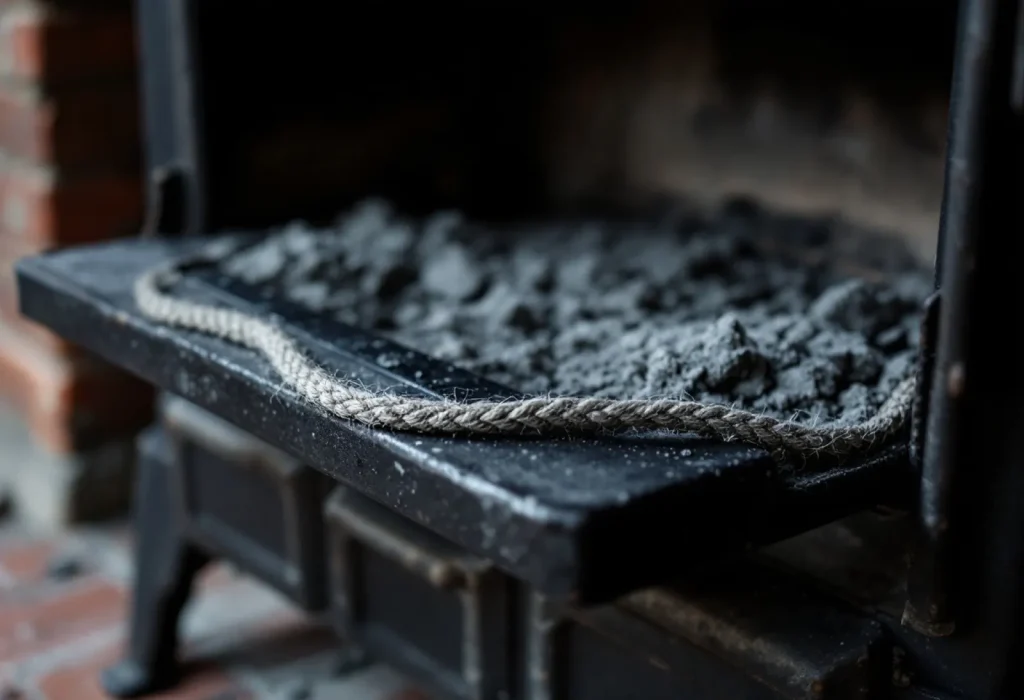
The short answer
An asbestos wood stove gasket cannot be identified by looking at it: CPSC lists door gaskets in wood and coal stoves as an asbestos source, and only a label or a lab test settles it. A lab uses polarized light microscopy, and above 1 percent is asbestos under 40 CFR 61.141. Today’s replacement is fiberglass rope rated to 1000°F or ceramic fiber rated to 2300°F.
Which seals on a wood stove could hold asbestos: door rope, glass tape or the flue collar?
CPSC's Asbestos in the Home guide names two stove items outright. It lists door gaskets in furnaces, wood stoves and coal stoves, and says worn seals can release asbestos fibers during use. It also lists cement sheet, millboard and paper used as insulation around furnaces and woodburning stoves, and says walls and floors around woodburning stoves may be protected with asbestos paper, millboard or cement sheets.
The other seals are not named by CPSC, but the federal air rule does not split hairs by location. 40 CFR 61.141 defines Category I nonfriable asbestos containing material as asbestos containing packings, gaskets, resilient floor covering and asphalt roofing products above 1 percent asbestos. A flue collar packing, a glass tape and an ash pan door rope are all gaskets or packings under that wording, so each gets sampled separately rather than assumed from the door result.
A fireplace insert, a masonry firebox and an old surround are a different job, and they are covered on the asbestos fireplace page. Grey cement vent pipe leaving the stove room is its own material class, explained on the asbestos flue pipe page.
Does an old grey rope look different from a 1000°F fiberglass replacement?
Not reliably. CPSC's Asbestos in the Home guide says you cannot tell whether a material contains asbestos simply by looking at it unless it is labelled, and EPA's homeowner asbestos page (updated 25 June 2026) repeats the same sentence. Colour is a poor clue: Rutland sells its graphite impregnated Grapho-Glas fiberglass rope in black and its window tape in black or white, per the Rutland window gasket page.
What a look can tell you is condition, which drives urgency. 40 CFR 61.141 defines friable material as material above 1 percent asbestos that, when dry, can be crumbled, pulverized or reduced to powder by hand pressure. A door rope that sheds fibers when the door closes is behaving the way the CPSC warning describes; a hard, intact rope that seals the door is not. The difference between those two states is laid out on the friable asbestos page.
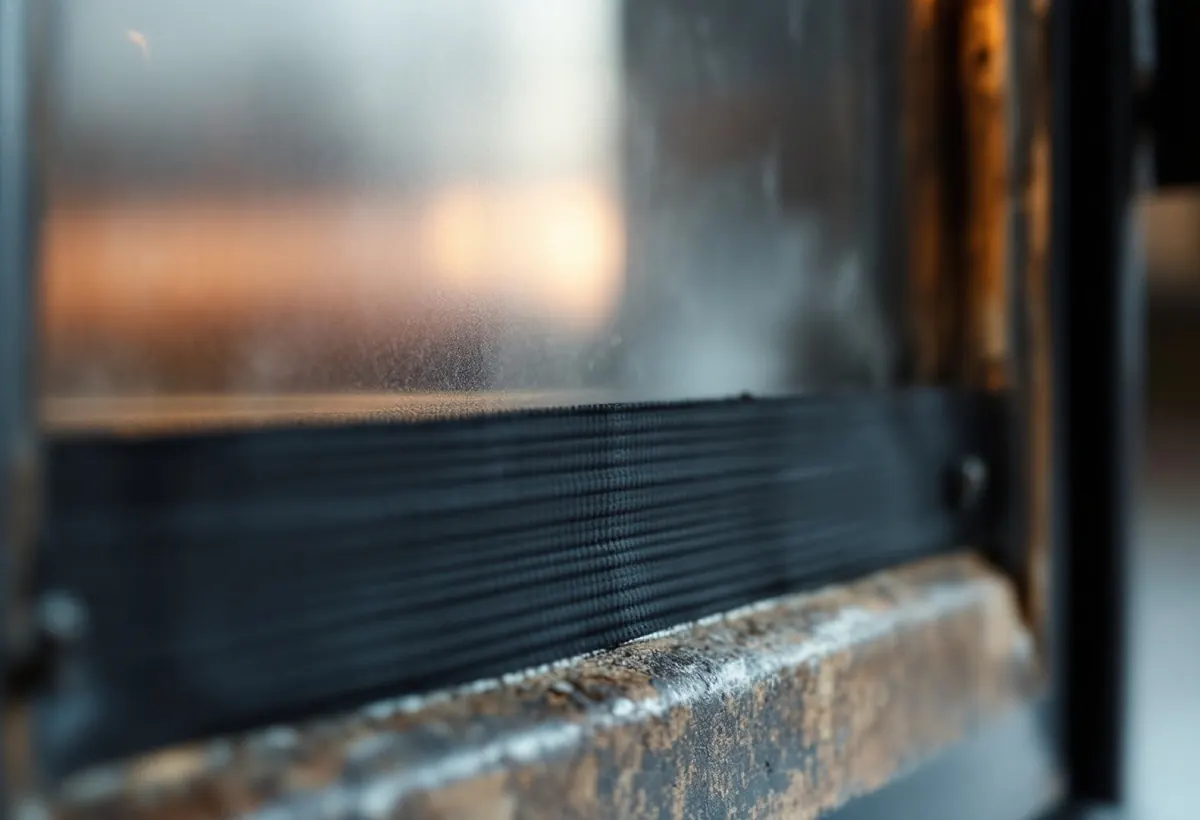
Identification table: five stove seals, the rule that covers each, and the replacement rating
The table matches the numbers on the diagram. The third column is the federal status of new chrysotile product under 40 CFR 751.509; the last column quotes maker pages (Rutland Grapho-Glas rope page, NUTEC MaxBraid 2300 page) as printed on 16 November 2026.
| Seal (diagram number) | Who names it | Federal rule on new chrysotile product | How a lab confirms | Modern replacement rating |
|---|---|---|---|---|
| Loading door rope (2) | Named by CPSC: door gaskets in wood and coal stoves | Other gasket: consumer manufacture, import and sale barred after 25 Nov 2024 | PLM bulk, EPA 600/R-93/116; above 1 percent is ACM (40 CFR 61.141) | Fiberglass rope 1000°F (Rutland); ceramic fiber rope 2300°F (NUTEC) |
| Ash pan door rope (4) | Door gasket, same CPSC listing | Other gasket: barred after 25 Nov 2024 | PLM bulk, EPA 600/R-93/116; above 1 percent is ACM (40 CFR 61.141); sample apart from the main door | Fiberglass rope 1000°F (Rutland) |
| Glass window tape (3) | Not named by CPSC; Category I gasket under 40 CFR 61.141 | Other gasket: barred after 25 Nov 2024 | PLM bulk, EPA 600/R-93/116; above 1 percent is ACM (40 CFR 61.141); send tape and any adhesive layer | Self adhesive fiberglass tape 1000°F (Rutland) |
| Flue collar packing (1) | Not named by CPSC; packing is Category I under 40 CFR 61.141 | Other gasket: barred after 25 Nov 2024 | PLM bulk, EPA 600/R-93/116; above 1 percent is ACM (40 CFR 61.141) | Per the stove maker’s manual; gasket cement rated 2000°F (Rutland 77E) |
| Wall or floor shield (5) | Named by CPSC: millboard, cement sheet, paper | Not a gasket; no 1989 rule stage survived for millboard (40 CFR 763.165) | PLM bulk; point count if a visual estimate is under 10 percent | Not a gasket; follow listed clearances in the stove manual |
No primary source found for this page dates when stove makers switched door rope from asbestos to fiberglass. The federal record shows why no single cutoff year exists: the 1989 ban was mostly vacated in 1991, and new consumer gaskets were only barred in November 2024. The order of those events is next.
What did the 1989 EPA ban, the 1991 court ruling and the 2024 chrysotile rule each do to stove gaskets?
EPA's ban and phase-out page (updated 19 May 2026) says EPA issued a final rule on 12 July 1989 banning most asbestos containing products, and that in 1991 the Fifth Circuit Court of Appeals in New Orleans overturned it. What survived is short: flooring felt, rollboard, corrugated, commercial and specialty paper, and new uses. No gasket appears on that list, so under federal TSCA rules new stove door rope stayed legal to make and sell from 1991 until November 2024. The fuller history of what was and was not banned sits on the when was asbestos banned page.
| Date | What happened | Primary source |
|---|---|---|
| 12 Jul 1989 | EPA final rule bans most asbestos products, 54 FR 29460 | EPA's ban and phase-out page |
| 1991 | Fifth Circuit Court of Appeals overturns most of the 1989 rule | EPA's ban and phase-out page |
| 27 Aug 1990 and 26 Aug 1996 | Surviving bans: flooring felt and new uses (1990); commercial, corrugated and specialty paper and rollboard (1996). No gasket or millboard entry | 40 CFR 763.165 |
| 28 Mar 2024 | TSCA chrysotile rule published, 89 FR 22005; defines gasket and other gaskets | 40 CFR Part 751, Subpart F |
| 25 Nov 2024 | Manufacture, import, processing and distribution of chrysotile other gaskets for consumer use barred | 40 CFR 751.509(e) |
| 27 May 2026 | Sheet gaskets for chemical production barred, with exceptions | 40 CFR 751.509(a) |
| 28 May 2029 and 31 Dec 2037 | Last dates for titanium dioxide and nuclear sheet gaskets (Savannah River Site to 2037) | 40 CFR 751.509(b), (c) |
The 2024 rule, codified at 40 CFR Part 751, Subpart F, applies to chrysotile asbestos, CASRN 132207-32-0; the differences between fiber types are covered on the types of asbestos page. It defines a gasket as an article used to form a leakproof seal between fixed components, and other gaskets as gaskets other than sheet gaskets in chemical production. A wood stove door rope falls in the other gaskets bucket.
Does the 2024 rule make the rope already in your stove illegal to keep?
No. 40 CFR 751.509(f)(2) states that other gaskets already installed for consumer use on 25 November 2024 are not subject to the distribution in commerce prohibition. The rule stops new chrysotile gaskets reaching the consumer market; it does not order anyone to pull a seal out of a working stove.
Two practical effects follow. A replacement rope bought new in the United States after 25 November 2024 should not be chrysotile, because making, importing, processing or distributing it for consumer use is barred under paragraph (e). And the old gasket stays a regulated waste question when it does come out, under the separate air rule at 40 CFR 61.150 and state law, not under the TSCA rule.
How does a lab confirm a gasket by PLM, and what result counts as asbestos?
The test is polarized light microscopy on a bulk sample. 40 CFR 61.141 sets the line: material containing more than 1 percent asbestos, measured by the PLM method in Appendix E to Subpart E of 40 CFR Part 763, is asbestos containing. The same definition says that when a non point count method reads under 10 percent, the content is confirmed by point counting with PLM. A gasket read at a trace by visual estimate should be point counted before anyone relies on a negative.
Accreditation matters more than price for a single sample. The NIST NVLAP asbestos programme accredits labs for PLM bulk analysis under EPA 600/R-93/116, the 1993 Method for the Determination of Asbestos in Bulk Building Materials, and publishes a directory of accredited labs. Ask the lab three things: is the PLM method on its NVLAP scope, will it point count a result under 10 percent, and does it report rope and adhesive as separate layers. Choosing a lab is covered on the asbestos testing lab page.
Taking the sample is the risky step. EPA's homeowner asbestos page says taking samples yourself is not recommended, and CPSC adds that sampling done incorrectly can be more hazardous than leaving the material alone. Where a sample is taken, CPSC’s guide says to wet the material with a fine mist of water containing a few drops of detergent first.
Why is replacement rope fiberglass or ceramic, and what temperature does each carry?
The Rutland Grapho-Glas rope page rates its graphite impregnated fiberglass rope up to 1000°F (530°C) and sells it in 1/4 inch to 1 inch rope plus a 5/8 by 3/16 inch flat tape. The window gasket carries the same 1000°F rating and goes on by peeling off a backing and wrapping the glass edge, with no cement, per the Rutland window gasket page. Ceramic fiber rope sits higher: the NUTEC MaxBraid 2300 page lists a maximum use temperature of 2300°F (1260°C) in diameters from 1/4 inch to 2 inches.
Computed from those printed figures, ceramic fiber rope is rated 2.3 times the fiberglass door rope, and the gasket cement at 2000°F is rated 2 times the rope it holds, per the Rutland E-Z Spread cement page. The low bar is a trap: the Rutland insulation strip page rates its self adhesive insert seal at 250°F, 4 times lower than door rope, so it belongs between an insert and masonry, never in a door channel.
Diameter is set by the stove, not the chart. Rutland’s kit runs 5/16, 3/8, 1/2, 5/8, 3/4 and 7/8 inch rope in 7 foot lengths, and the stove maker’s manual names the size for each channel. Matching the old rope’s diameter by eye works only after the old rope has been tested and handled as the result requires.
What has to happen before an untested door rope comes out of its channel?
Replacement directions are written for new, non asbestos rope, and they assume a scrape. The Rutland gasket kit directions tell the user to work on a cold stove, remove all old gasketing and adhesive, clean to bare metal in the gasket channel, then lay a 1/8 inch bead of cement and heat cure within 30 days. Scraping a rope and its old cement bed out of a channel is the disturbance that CPSC’s worn seal warning is about, which is why the lab result comes first.
If the result is above 1 percent, CPSC's Asbestos in the Home guide says major repairs must be done only by a professional trained in safely handling asbestos, and that minor repairs should also be done by professionals because of the exposure risk. For a single family house, the federal air rule usually is not the binding law: 40 CFR 61.141 defines a regulated facility as excluding residential buildings with four or fewer dwelling units. State and local agencies fill that gap, and CPSC says to dispose of asbestos materials according to state and local procedures. The bagging, labelling and landfill steps are on the how to dispose of asbestos page.
For contractors
A stove in a commercial building, a rental block of five or more units or a demolition job is a facility under 40 CFR 61.141, and the waste rules in 40 CFR 61.150 apply: wet the waste, seal it while wet in leak tight containers, and label it. Chimney sweeping, relining and stove servicing are trades this publication does not cover, so the venting side of the job goes to a chimney professional.
Out of scope: health effects of asbestos are not covered on this page. EPA's homeowner asbestos page and CPSC are the starting points.
Questions people actually ask
What is a wood stove gasket made of today?
New door and glass gaskets sold in the United States are fiberglass or ceramic fiber. Rutland’s Grapho-Glas rope is graphite impregnated braided fiberglass rated to 1000°F, and NUTEC’s MaxBraid ceramic fiber rope is rated to 2300°F. Since 25 November 2024, 40 CFR 751.509(e) bars making, importing or distributing chrysotile gaskets for consumer use.
What is the difference between an asbestos gasket and a non asbestos gasket?
The fiber, not the shape. Both come as rope, braid or flat tape, and both can be grey, white or black. Under 40 CFR 61.141 a gasket above 1 percent asbestos by polarized light microscopy is Category I asbestos containing material; one at or below 1 percent is not. Only a lab report on the sample answers it.
What is the 3-2-10 rule for wood stoves?
It is a chimney height rule, not a gasket rule. IRC section R1003.9 in the 2006 text says a chimney must extend at least 2 feet higher than any part of a building within 10 feet, and at least 3 feet above the highest point where it passes through the roof. Check the edition your town adopted with the building department.
Can I keep using a stove with an old asbestos door gasket?
Federal law does not force removal: 40 CFR 751.509(f)(2) exempts gaskets already installed for consumer use on 25 November 2024. Condition is the issue. CPSC says worn seals can release fibers during use, so a rope that is fraying, flattened or leaking smoke is the trigger to test it and plan a professional replacement.
Can you still buy asbestos stove rope?
Not legally as new consumer product in the United States after 25 November 2024. 40 CFR 751.509(e) prohibits manufacturing, importing, processing and distributing chrysotile other gaskets for consumer use from that date. Old stock or salvage parts bought secondhand are a reason to send a sample to an NVLAP accredited lab before installing anything.
Sources
- CPSC's Asbestos in the Home guide, U.S. Consumer Product Safety Commission, published with EPA; undated. Retrieved 16 November 2026.
- EPA's homeowner asbestos page, U.S. Environmental Protection Agency, last updated 25 June 2026. Retrieved 16 November 2026.
- EPA's ban and phase-out page, U.S. Environmental Protection Agency, last updated 19 May 2026. Retrieved 16 November 2026.
- 40 CFR 763.165, manufacture and importation prohibitions, via Cornell Legal Information Institute. Retrieved 16 November 2026.
- 40 CFR Part 751, Subpart F and 40 CFR 751.509, chrysotile asbestos (89 FR 22005, 28 March 2024), via eCFR. Retrieved 16 November 2026.
- 40 CFR 61.141 and 40 CFR 61.150, asbestos NESHAP definitions and waste disposal standard, via eCFR. Retrieved 16 November 2026.
- NIST NVLAP asbestos programme, National Institute of Standards and Technology. Retrieved 16 November 2026.
- Rutland Grapho-Glas rope page, Rutland gasket kit directions, Rutland window gasket page, Rutland E-Z Spread cement page and Rutland insulation strip page, Rutland Products. Retrieved 16 November 2026.
- NUTEC MaxBraid 2300 page, NUTEC Group. Retrieved 16 November 2026.
- IRC section R1003.9 (2006 text), International Residential Code 2006 chimney termination text as reproduced by Rumford Fireplaces. Retrieved 16 November 2026.
- Ratios between temperature ratings are arithmetic on the printed maker figures, computed when this page was built. Our methodology sets out the standing rules, and more federal asbestos rules sit in the standards hub.
Ratings and product lines change. Confirm the gasket size and material for your stove in the maker’s manual, and confirm sampling and disposal rules with your state asbestos program before work starts.