The short answer
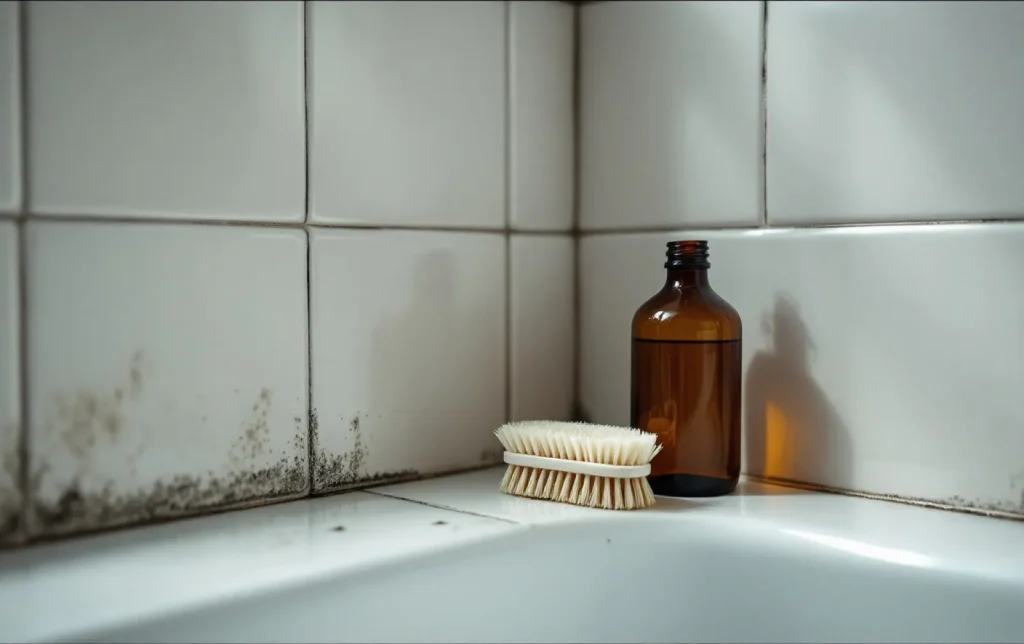
Does hydrogen peroxide kill mold? Partly. Drugstore 3% peroxide kills some spores on hard surfaces, but according to a 2022 International Journal of Food Microbiology report, 15 minutes at 3% cut dry Penicillium and Cladosporium spores by only 0.4 to 1.5 log, short of the 3 log fungicide bar. The brown bottle carries no mold directions, and moldy porous material still has to come out.
Is the brown 3% bottle actually registered to kill mold?
No. The Top Care 3% hydrogen peroxide drug label on DailyMed lists hydrogen peroxide 3% as a “first aid antiseptic/oral debriding agent”, regulated as an over-the-counter drug. Its directions cover minor cuts and a mouth rinse, and it says to keep the bottle “tightly closed and in a dark place at room temperature”. Nothing on that FDA label mentions mold, a contact time on a surface or a test organism.
Mold claims on a peroxide product come from EPA pesticide registration instead. The EPA product search for hydrogen peroxide returned 277 active, registered products on 11 November 2026. Reading each product record, 44 of them (16%) list MOLD/MILDEW among their target pests, and 30 of those 44 use hydrogen peroxide as the only active ingredient. The rest pair it with peracetic acid, quaternary ammonium compounds or silver.
Single-ingredient registrations with a mold or mildew listing run from 0.5% to 7.95% peroxide, per the EPA records. The four above 20% all pair peroxide with peracetic acid, such as Oxy 5 (EPA Reg. No. 91209-1, 27% peroxide and 5.5% peracetic acid). A drugstore bottle sits inside the registered range by strength, yet only a registered label carries mold directions.
What do peroxide labels promise against mold, from 0.5% to 35%?
The table below climbs the strengths a homeowner can buy and quotes what each EPA-stamped label, or the FDA drug label, actually says about mold. Each EPA label PDF states it was accepted under the Federal Insecticide, Fungicide, and Rodenticide Act (FIFRA), so the wording matters: “cleans mold stains”, “inhibits growth” and “kills” are three different claims backed by three different tests.
| Strength and product | Mold claim, in the label’s words | Contact time and test organism | Label read |
|---|---|---|---|
| 0.5%: Oxivir TB (70627-56) | “Mildewcide”; mold and mildew stains listed as soils it cleans | 3 min, fungicidal against Trichophyton interdigitale (athlete’s foot fungus) | Oxivir TB label, EPA Reg. No. 70627-56 |
| 1.0%: H2Orange2 120 (69268-3) | “Kills and removes mold and mold stains” (2005 label) | 5 min for stains, then scrub; fungicide claim names Trichophyton | H2Orange2 120 label, EPA Reg. No. 69268-3 |
| 1.4%: Clorox Disinfecting Cleaner with Hydrogen Peroxide (67619-24) | Optional text: “To kill mold and fungi, let stand 3 minutes” | Fungi table lists Candida albicans, Candida auris, Trichophyton; no mold genus | Clorox Disinfecting Cleaner with Hydrogen Peroxide label, EPA Reg. No. 67619-24 |
| 2.4%: Proxi Home spray (85837-4) | “To control (and prevent) the growth of mold and mildew” on precleaned hard surfaces | Wet 3 min, air dry, repeat weekly; fungistatic against Aspergillus brasiliensis ATCC 9642 | Proxi Home label, EPA Reg. No. 85837-4 |
| 3.0%: drugstore bottle (FDA drug, Top Care) | None: first aid antiseptic and oral rinse | No surface contact time on the label | Top Care 3% hydrogen peroxide drug label on DailyMed |
| 3.0%: Kaboom shower, tub and tile (10772-21) | “Inhibits” mold and mildew growth on cotton and polyester fabric | Repeat every 21 days (no preclean) or 28 days (precleaned); Aspergillus niger and Penicillium variable | Kaboom label, EPA Reg. No. 10772-21 |
| 7.6%: Oxivir Three 64 concentrate (70627-82) | “To Control Mold and Mildew”: wet, air dry, repeat weekly or when growth reappears | Fungicidal at 1:64 (2 oz per gallon, about 0.12% in use) for 3 min against Candida and Trichophyton | Oxivir Three 64 label, EPA Reg. No. 70627-82 |
| 6% to 10%: hair bleach | None | Not a cleaner; higher strengths “can cause burns” | National Capital Poison Center |
| 35%: “food grade” | None | Not food; serious internal burns if swallowed, eye and skin burns possible | National Capital Poison Center |
Two patterns stand out. Where these labels say “fungicidal”, the organisms they name are Trichophyton and Candida, not a household mold genus; the Clorox Disinfecting Cleaner with Hydrogen Peroxide label, EPA Reg. No. 67619-24 fungi table has no Aspergillus, Penicillium or Cladosporium row. Where a mold genus does appear, as Aspergillus niger and Penicillium variable on the Kaboom label, EPA Reg. No. 10772-21, the claim is to inhibit regrowth on fabric for 21 or 28 days, not to kill an existing colony. None of the 6 EPA labels in the table names Stachybotrys.
How many minutes does peroxide need to kill mold spores?
Longer than the 10 minute figure most guides repeat, and on dry spores sometimes longer than any home soak. Visconti and colleagues, International Journal of Food Microbiology 2022 summarise their 2021 trial on dry-harvested spores grown under moderate water stress, which the authors call “food plant” spores. After 15 minutes at 3%, the paper reports log reductions ranging from 0.4 to 1.5, which leaves roughly 3% to 40% of spores alive (our arithmetic: survivors equal 10 to the minus log).
The same paper explains why home results vary. As the paper reports, spores of Penicillium commune grown the standard laboratory way were cut by more than 4.1 log after 10 minutes at 3%, while dry spores of the same isolate grown under water stress “remained viable”. The European CEN carrier test, according to the paper, counts a product as fungicidal only at 3 log or better, a bar no 3% result in the chart reaches.
Strength helps some species and not others. A 7.9% peroxide sanitizer held for 20 minutes passed 4.5 log on Aspergillus flavus and 5.2 log on both Penicillium isolates, per the study, yet Mucor circinelloides reached only 0.5 log and Cladosporium cladosporioides 1.4 log. A higher percent is therefore no guarantee for every genus on a wall.
Rabby and colleagues, International Journal of Microbiology 2025 found the same gap at much lower strength. After 5 minutes, 0.2% peroxide removed 4.81 log of Escherichia coli on a plate but only 0.44 log of Aspergillus niger spores, and less on rough tile than on smooth steel:
| Surface, A. niger, 5 minutes | 0.2% hydrogen peroxide | 10% sodium hypochlorite | Acetic acid and peroxide blend |
|---|---|---|---|
| Petri plate | 0.44 log (63.3%) | 0.41 log (60.8%) | 5.84 log (over 99.999%) |
| Stainless steel | 0.33 log (52.9%) | 0.29 log (49.0%) | 5.99 log (over 99.999%) |
| Ceramic tile | 0.26 log (45.6%) | 0.23 log (41.5%) | 5.83 log (over 99.999%) |
Which surfaces can take peroxide, and which moldy ones go in a bag?
Every EPA peroxide label read for this page limits its mold and disinfection directions to hard, nonporous surfaces. That matches EPA's Mold Remediation in Schools and Commercial Buildings, Chapter 3, which says porous materials that are wet and growing mold “may have to be discarded” because mold fills their crevices and can be impossible to remove completely.
| Surface | What the label or agency says | Practical call | Source |
|---|---|---|---|
| Glazed tile, glass, sealed fiberglass, laminate, hard plastic, chrome | Yes, listed hard nonporous surfaces | Scrub, wet the contact time, wipe | Clorox Disinfecting Cleaner with Hydrogen Peroxide label, EPA Reg. No. 67619-24 |
| Painted drywall and painted wood | “Porous painted surfaces” and “painted wood” are on the avoid list | Test a hidden spot; wet drywall with growth is a removal job | Clorox Disinfecting Cleaner with Hydrogen Peroxide label, EPA Reg. No. 67619-24 |
| Unfinished, oiled or waxed wood | “DO NOT USE” | Peroxide is also a wood bleach (see the 35% section) | Kaboom label, EPA Reg. No. 10772-21 |
| Natural stone, unsealed marble and granite | “DO NOT USE” on natural stone and natural marble | Avoid | Kaboom label, EPA Reg. No. 10772-21 |
| Clothes and fabric | 3% is “safe for all fibers”; test dyed fabric | Rinse thoroughly; not on wool or silk per the 10772-21 label | University of Kentucky Cooperative Extension guide HE 2-840 |
| Carpet, ceiling tile, upholstery | Carpet is on the avoid list | “May have to be thrown away” if moldy, per EPA | EPA's A Brief Guide to Mold, Moisture and Your Home |
| Brass, copper, aluminum, galvanized steel | Avoid contact | NIOSH lists copper, brass, zinc and iron as incompatible | NIOSH Pocket Guide entry for hydrogen peroxide |
Two common searches fall outside every label in that table. None of the 6 EPA peroxide labels read here lists silicone caulk or concrete as a use site, so any claim that 3% sterilises a stained shower bead or a basement slab has no EPA label behind it. On fabric, the University of Kentucky Cooperative Extension guide HE 2-840 recommends the 3% antiseptic strength, not hair-bleach strength, and says to test dyed fabric first. Laundering steps for mildewed clothing are on our page about mold on clothes.
Does peroxide beat vinegar or bleach, and can you combine them?
In one head-to-head on a household mold species, Rabby and colleagues, International Journal of Microbiology 2025 measured 0.2% peroxide and 10% sodium hypochlorite within 0.05 log of each other on Aspergillus niger at 5 minutes on all three surfaces. The clear winner in that study was neither: a premixed blend of acetic acid and peroxide that had formed 0.1% peracetic acid, which passed 5.8 log everywhere. Vinegar’s own record is on our page asking does vinegar kill mold, and bleach’s is at does bleach kill mold.
That result is not a recipe. The New Jersey Department of Health hazard alert lists hydrogen peroxide plus vinegar among dangerous mixes because together they form peracetic acid, an irritant to eyes and skin. Registered products that contain it are made at a fixed, labelled strength: Clorox’s 67619-35 carries 5% peroxide with 0.127% peracetic acid and a DANGER signal word in the EPA record. A bottle mixed at home has no known strength and no label. Combinations to avoid are set out in bleach and vinegar for mold.
Ammonia fares worse than either; the EPA registration record for household ammonia is on does ammonia kill mold. For registered products sorted by active ingredient and label claim, use the mold killer comparison, which sets peroxide beside the other EPA-registered actives.
Why does 35% food grade peroxide not belong on a moldy wall?
The National Capital Poison Center gives the ladder plainly: household peroxide is 3%, hair bleach is 6 to 10%, “food grade” is 35%, and industry uses up to 90%. Food grade is about 12 times the drugstore strength, “is not food” and can cause eye and skin burns. No EPA mold registration in the 44-product count above sells a home product at that strength.
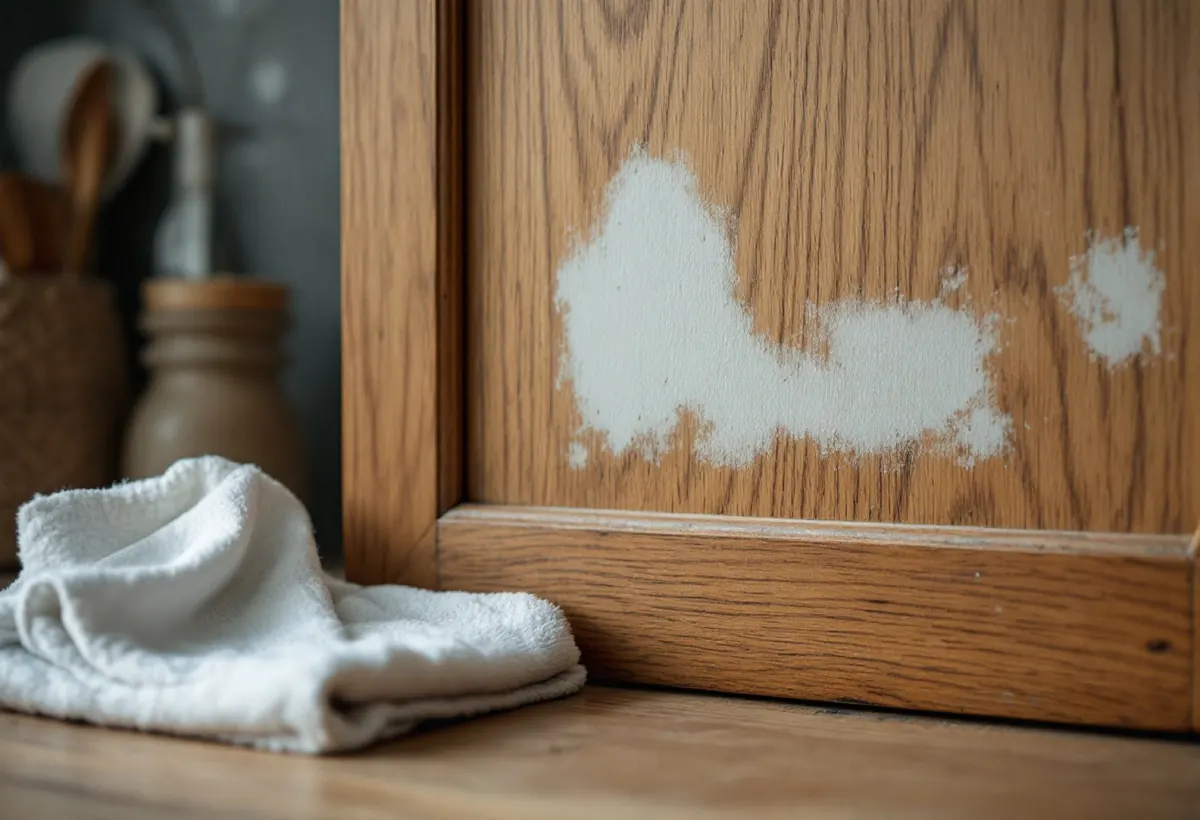
It also bleaches what it touches. The USDA Forest Products Laboratory note FPL-0165 describes 30 or 35% peroxide as one of the most powerful wood bleaches, applied over a coat of sodium hydroxide at 4 pounds per 10 gallons, and lists oak, birch, maple and walnut as easy to lighten. Sprayed on a stained cabinet or trim, a high-strength solution can leave a pale patch where the mold stain was.
Vapour is the other problem. The NIOSH Pocket Guide entry for hydrogen peroxide sets the OSHA permissible exposure limit at 1 ppm as an 8 hour average and the immediately dangerous level at 75 ppm, and warns that contact with combustible material may cause spontaneous combustion. Misting a closet with strong peroxide puts a person in exactly the air those limits are written for.
When is a peroxide spray the wrong tool for a moldy room?
Size first. EPA's A Brief Guide to Mold, Moisture and Your Home says a homeowner can often handle mold under about 10 square feet, and that water-damaged areas should be dried within 24 to 48 hours. Its cleanup instruction for hard surfaces is detergent and water, then dry completely, with no biocide step at all.
Killing is not the goal. EPA's answer on bleach for mold and EPA's Mold Remediation in Schools and Commercial Buildings, Chapter 3 both say a biocide is “not recommended as a routine practice” during mold cleanup, and that the mold has to be cleaned up, not just killed, because remaining spores stay dormant once the moisture source is fixed. A peroxide pass after scrubbing can lift a dark stain on grout; it does not replace removing the growth. The full sequence for larger jobs is in our mold remediation process breakdown.
Out of scope: this page covers chemistry, labels and surfaces only. For how mold exposure affects people, see the CDC mold pages and EPA’s guide linked above.
Questions people actually ask
How long should hydrogen peroxide sit on mold?
Follow a registered label if you use one: the Proxi Home 85837-4 label says keep the surface wet 3 minutes, and the Kaboom 10772-21 label says 10 minutes for its fungus claim. Per the DailyMed label, drugstore 3% has no surface directions. A 2022 study reports that 15 minutes at 3% killed only 60% to 97% of dry mold spores, so scrubbing and drying do most of the work.
Does hydrogen peroxide kill mold on clothes?
It can lighten mildew stains, and the University of Kentucky Extension guide HE 2-840 calls 3% peroxide safe for all fibers if dyed fabric is tested first and rinsed well. The only EPA peroxide label here with a fabric mold claim, Kaboom 10772-21, promises to inhibit regrowth for 21 or 28 days, not to kill existing growth, and excludes wool and silk.
Can you spray hydrogen peroxide and vinegar one after the other?
Not as a mix. The New Jersey Department of Health warns that peroxide and vinegar together form peracetic acid. If you use both on one hard surface, rinse with plain water and let it dry between products so the two never share a wet film, and never pour them into one bottle. Clorox’s registered peroxide and peracetic product, EPA Reg. No. 67619-35, carries a DANGER signal word.
Does hydrogen peroxide go bad in the bottle?
Storage matters. The National Capital Poison Center notes household 3% bottles are opaque, and the Top Care drug label says to keep the bottle tightly closed, in a dark place, at room temperature, and not to shake it. Neither source gives a shelf life, so an old, opened bottle is not a reliable full-strength solution for any contact time.
What permanently gets rid of mold?
Removing it and the water that feeds it. EPA’s mold guide says dry water-damaged materials within 24 to 48 hours, scrub hard surfaces with detergent and water, and discard moldy porous items such as ceiling tiles and carpet. No peroxide label read here claims a permanent result; the Oxivir Three 64 and Proxi labels say repeat weekly.
Sources
- EPA product search for hydrogen peroxide, US EPA Pesticide Product and Label System API, and per product records at ppls/{reg no.} for all 277 active registrations. Retrieved 11 November 2026.
- EPA-accepted labels: Oxivir TB label, EPA Reg. No. 70627-56, 25 October 2023; H2Orange2 120 label, EPA Reg. No. 69268-3, 7 June 2005; Clorox Disinfecting Cleaner with Hydrogen Peroxide label, EPA Reg. No. 67619-24, 12 February 2026; Proxi Home label, EPA Reg. No. 85837-4, 22 April 2025; Kaboom label, EPA Reg. No. 10772-21, 2 November 2026; Oxivir Three 64 label, EPA Reg. No. 70627-82, 2 December 2025. US EPA. Retrieved 11 November 2026.
- Top Care 3% hydrogen peroxide drug label on DailyMed, Hydrogen peroxide liquid, Topco Associates, updated 7 October 2026, US National Library of Medicine. Retrieved 11 November 2026.
- National Capital Poison Center, Is hydrogen peroxide safe?, webPOISONCONTROL. Retrieved 11 November 2026.
- NIOSH Pocket Guide entry for hydrogen peroxide, Hydrogen peroxide, NIOSH Pocket Guide to Chemical Hazards, CDC. Retrieved 11 November 2026.
- Visconti and colleagues, International Journal of Food Microbiology 2022, Impact of temperature application and concentration of commercial sanitizers on inactivation of food-plant fungal spores, vol. 366, 109560, HAL open archive copy. Retrieved 11 November 2026.
- Rabby and colleagues, International Journal of Microbiology 2025, Comparative Evaluation of a Disinfectant Formulation Comprising Hydrogen Peroxide, Peracetic Acid, and Acetic Acid, article 2602317. Retrieved 11 November 2026.
- EPA's A Brief Guide to Mold, Moisture and Your Home, US EPA, last updated 18 February 2026. Retrieved 11 November 2026.
- EPA's answer on bleach for mold, Should I use bleach to clean up mold?, US EPA, last updated 8 September 2026. Retrieved 11 November 2026.
- EPA's Mold Remediation in Schools and Commercial Buildings, Chapter 3, US EPA, last updated 29 April 2026. Retrieved 11 November 2026.
- New Jersey Department of Health hazard alert, Mixing Bleach with Other Cleaning Products Can Be Deadly, New Jersey Department of Health. Retrieved 11 November 2026.
- University of Kentucky Cooperative Extension guide HE 2-840, Stain Removal for Washable Fabrics, University of Kentucky College of Agriculture, 1998. Retrieved 11 November 2026.
- USDA Forest Products Laboratory note FPL-0165, Bleaching Wood, USDA Forest Service, copy hosted by WoodCentral. Retrieved 11 November 2026.
- CDC, About Mold and Your Health, US CDC. Retrieved 11 November 2026.
- How this page was built is described in our methodology, and more mold pages are on the mold hub.
Registrations and labels change. Search the EPA Reg. No. on your own bottle in EPA’s label system and follow that label; a drugstore bottle has no mold directions to follow.