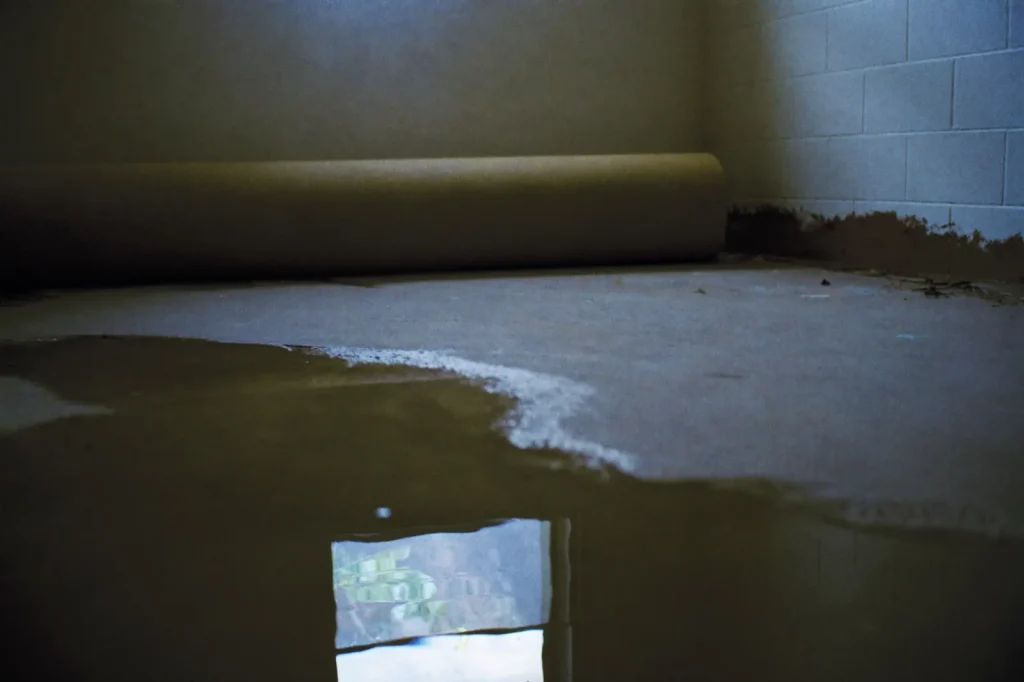
The short answer
The water damage restoration process runs in six stages: stop the source and cut power, inspect and set the water category and drying goals, extract water and remove what cannot be saved within 24 to 48 hours, dry with daily logged readings for about 1 to 3 days, confirm the dry standard, then hand off to rebuild. Each stage leaves a record the adjuster will ask for.
On this page
- Hour 0: before anyone extracts water
- Category 1, 2 or 3 on the first visit
- Days 0 to 2: extraction and tear-out
- How much drying equipment the guidance expects
- What the daily drying log holds
- The record an adjuster asks for at each step
- When drying ends and rebuild begins
- For contractors
- Questions people actually ask
Hour 0: what has to happen before anyone extracts water?
Power comes first. The OSHA flood response page says that if water has been present anywhere near electrical circuits and electrical equipment, turn off the power at the main breaker or fuse on the service panel, and never enter flooded areas or touch electrical equipment if the ground is wet. If the panel itself sits in standing water, that instruction is for the utility or an electrician, not a homeowner with a flashlight.
Stopping the source is the owner’s job under the standard. The IICRC S500 page states that determining and correcting the source of water intrusion is the responsibility of the property owner and not the restorer, which is why a plumber’s invoice for the failed supply line usually sits outside the restoration estimate. Plumbing repair belongs to theplumbingbrief.com.
The first phone call is already part of the job. Section 10.5 of ANSI/IICRC S500 (5th edition, 2021), as quoted in the IICRC S500 consensus body position statement of 16 March 2026, lists what the restorer should gather before mobilizing: structure type and use; source, date and time of the intrusion; whether the source is controlled; the number of rooms and floors affected; suspect contaminants; previous water damage; affected materials; age of the structure; and number of occupants. Write down the date and time now: the flood policy proof of loss asks for exactly that.
How is Category 1, 2 or 3 decided on the first visit?
S500 section 10.6 sets the minimum list for the initial response: a site specific safety survey, the customer’s priorities, verifying the source, mapping how far the water migrated, a preliminary determination, pre-existing damage, immediate secondary damage concerns, and dry standards and drying goals. The IICRC S500 consensus body position statement of 16 March 2026 quotes that list verbatim.
The preliminary determination is the category call, and it changes the scope. Under S500 section 10.6.7, Category 1 water lets the restorer proceed without contamination controls such as containment barriers or pressure differentials; for Category 2 or 3, remediation should occur before restorative drying, and the restorer shall use contamination controls and worker protection. The definitions and examples sit on our water categories page.
Storm water is the live dispute. On 16 March 2026 the S500 consensus body stated that top-down water ingress, wind-driven rain and water from weather related events are not automatically Category 3: the word ‘can’ in the definition marks a possibility, not the standard of care, and the category must rest on conditions observed at the loss. A roof leak logged as Category 3 with no observed contamination is now easier for an IICRC-literate adjuster to challenge.
Days 0 to 2: what gets extracted, and what comes out of the wall?
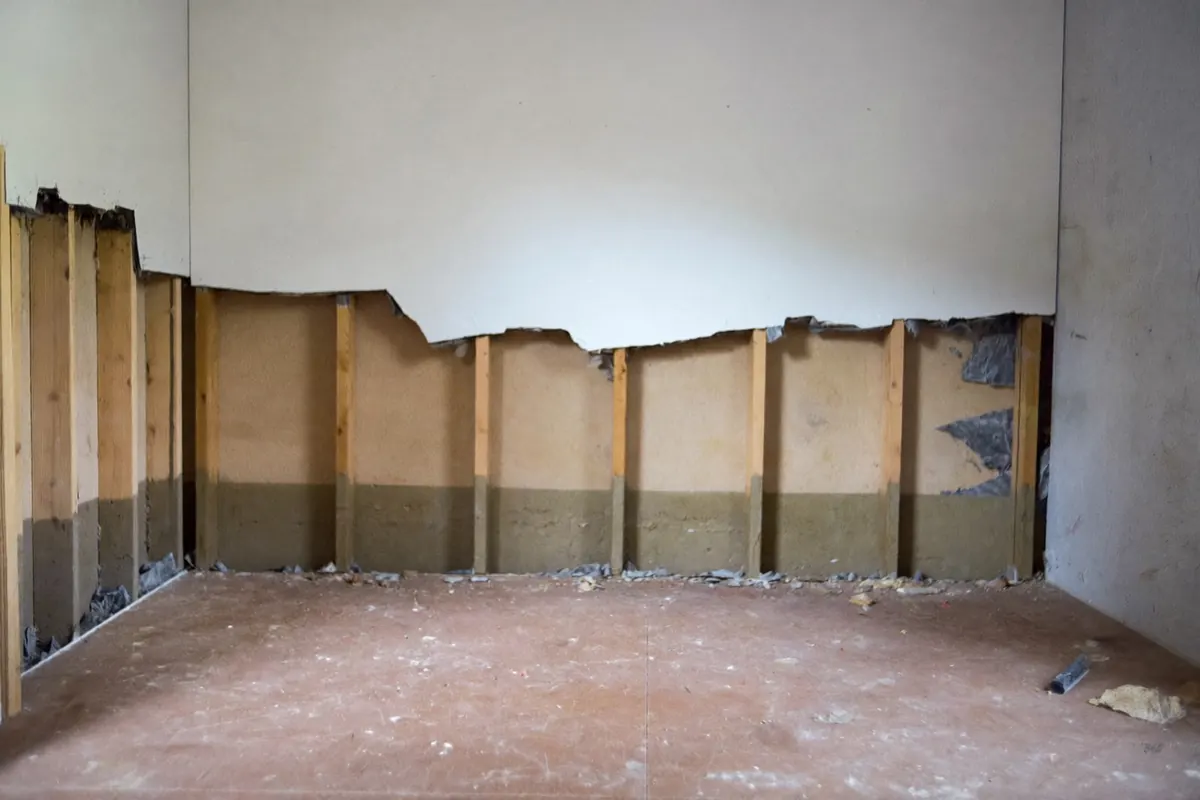
The clock that drives tear-out comes from EPA Mold Remediation in Schools and Commercial Buildings (EPA 402-K-01-001, September 2008). Its Table 1 sets guidelines for clean water damage handled within 24 to 48 hours, and EPA adds that if materials have been wet longer than 48 hours, its mold remediation table applies instead. Standing water comes out first by pump or extraction unit; the water extraction page covers the equipment.
| Material (EPA Table 1) | EPA action for clean water | What that means on day 0 to 2 |
|---|---|---|
| Ceiling tiles | Discard and replace | No drying charge; removal and replacement |
| Cellulose insulation | Discard and replace | Wall or attic cavity opened |
| Fiberglass insulation | Discard and replace | Usually goes out with the flood cut |
| Drywall | May be dried in place if no obvious swelling and seams intact; if not, remove | Swollen board or open seams: cut it out |
| Carpet and backing | Extraction vacuum, dehumidifier, fans; dry within 24 to 48 hours | Salvage only if the clock can be met |
| Upholstered furniture | Extract, dehumidify; may be difficult to dry within 48 hours | Valuable pieces go to a contents specialist |
| Wood surfaces | Dehumidifiers, gentle heat, fans; pry wet paneling away from the wall | Caution with heat on hardwood floors |
Two paperwork traps sit inside tear-out. First, under FEMA bulletin W-13025a (14 May 2013), the flood policy does not pay to dry building material that is also claimed in a removal and replacement allowance, so the estimate cannot do both to the same wall. Second, in a home built before 1978, 40 CFR 745.83 treats work as minor repair only up to 6 square feet of painted surface per room, and never when it involves demolition of painted surface, so a flood cut is a renovation under the lead rule. 40 CFR 745.82(b) exempts emergency renovations from some steps, but not from cleaning verification or recordkeeping.
Wet gypsum board has its own page on when to save it and when to cut it, at wet drywall.
Days 1 to 3: how much drying equipment does the claims guidance expect?
The only public, numeric yardstick is FEMA bulletin W-13025a, written for flood claims under the Standard Flood Insurance Policy. When an invoice arrives without a properly completed drying log, FEMA tells adjusters to allow drying for 1, 2 or 3 days based on saturation, and to size equipment by formula. FEMA itself states the bulletin is not an industry drying standard, so read it as what a flood adjuster will allow, not how a room must be dried.
| Worked example: one 20 by 12 by 8 ft room, walls cut, tile on slab | FEMA W-13025a rule | Result |
|---|---|---|
| Affected volume | Length x width x height | 1,920 cubic feet |
| Low grain refrigerant (LGR) dehumidifier | Cubic feet / 50 = AHAM pints | 38.4 AHAM pints per day |
| Or desiccant dehumidifier | Cubic feet / 60 x 2 = CFM | 64 CFM |
| Air movers, day 1 | One per 16 LF of exposed perimeter sheathing (64 LF) | 4 air movers |
| Air movers, day 2 | 50% of the day 1 count | 2 air movers |
| Air movers, day 3 | Day 2 plus day 3 equals day 1 | 2 air movers |
| Air mover days allowed | 2 day job / 3 day job | 6 / 8 |
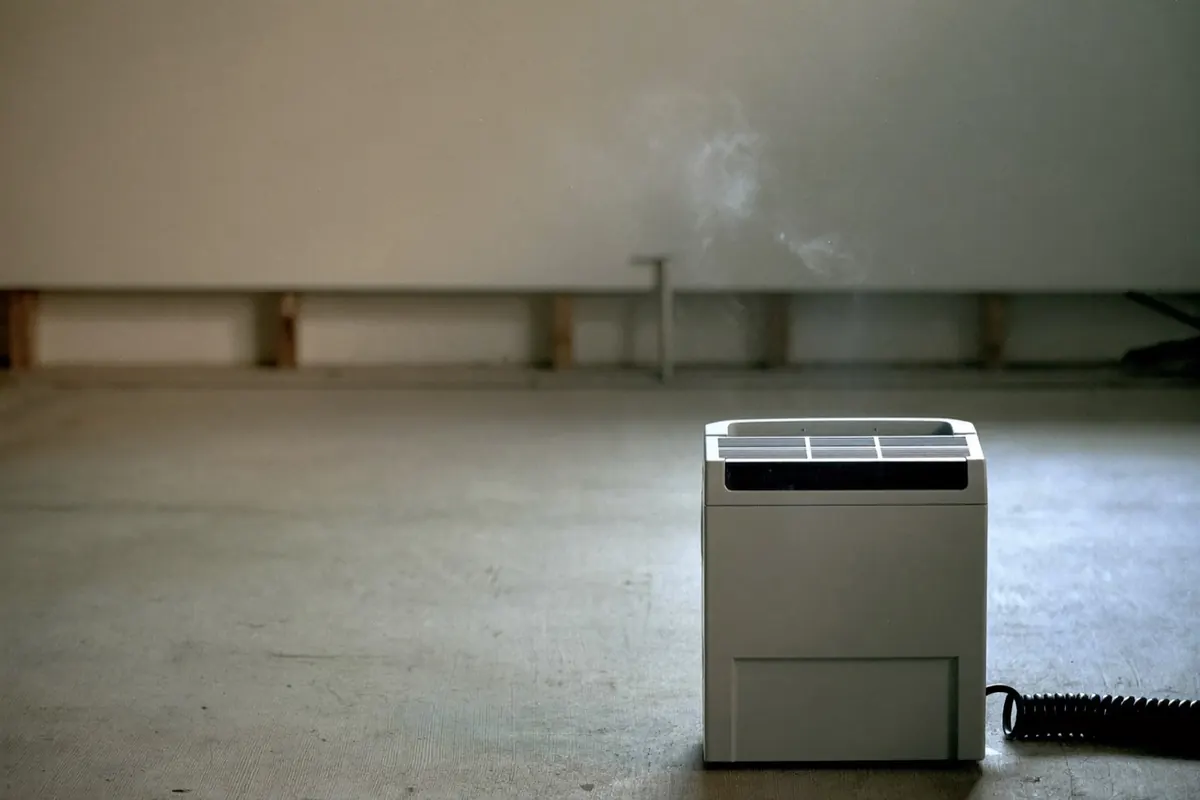
With a properly completed drying log, the same bulletin tells the adjuster to accept the number of units the log validates for the logged duration, plus supplemental heaters and labor for setup, daily monitoring and takedown. That one sentence is why restorers keep logs: per FEMA, the log, not the formula, sets the allowance. Drying science, including why LGR and desiccant units outperform standard dehumidifiers on bound water, is on the structural drying page.
What goes in the daily drying log, reading by reading?
FEMA bulletin W-13025a defines the document. A drying log records, every day:
- Temperature and relative humidity of indoor air and outdoor air.
- Moisture readings with the recorded location of affected and unaffected building materials (the unaffected readings are the dry reference).
- The drying goal and dry standard for each affected material.
- A moisture map.
- The daily operating status of the building HVAC system.
- Every instrument and piece of equipment the technician used.
The dry standard and drying goal are set on day 0, not at the end: S500 section 10.6 puts ‘establish dry standards and drying goals’ on the initial response list. A reading of 12 on a drywall scale means nothing until the log shows what the same meter showed on dry board in an unaffected room. How each meter scale reads, by material, is on our moisture meters page.
Step by step: which record does an adjuster ask for at each stage?
No ranking page pairs the steps with the paper. The table below does, using the Standard Flood Insurance Policy, 44 CFR Part 61 Appendix A(1) and FEMA W-13025a, the two public documents that spell out what a flood claim file must hold. Homeowners and commercial policies use their own forms, so read the duties after loss section of the actual policy.
| Step | When | What happens (source) | The record the adjuster asks for (source) |
|---|---|---|---|
| 1. First contact | Hour 0 | Source, date and time, rooms, materials, occupants (S500 10.5) | Date and time of loss; the SFIP proof of loss asks for both (VII.G.4.a) |
| 2. Power and safety | Hour 0 | Main breaker off if water near circuits (OSHA) | Power status; a generator for drying is not allowed if the building electrical system is inoperable (W-13025a item 4) |
| 3. Preliminary determination | Day 0 | Category call; contamination controls for Category 2 or 3 (S500 10.6.7) | Observed conditions behind the category; pre-existing damage noted (S500 10.6) |
| 4. Extraction | Day 0 to 1 | Pump-out, wet vacuum or specialized extraction | Method used; FEMA prices pump-out differently from extraction that salvages material (W-13025a item 1) |
| 5. Tear-out | Day 0 to 2 | Remove what EPA Table 1 says to discard | What was removed and why; nothing claimed both removed and dried (W-13025a non-covered item 1) |
| 6. Separate property | Day 0 to 2 | Damaged and undamaged property separated (SFIP VII.G.2) | Inventory with quantity, description, actual cash value and amount of loss, with bills and receipts (SFIP VII.G.3) |
| 7. Drying setup | Day 1 | Dehumidifiers, air movers, containment where needed | Unit type and count per area; LGR or desiccant capacity (W-13025a) |
| 8. Daily monitoring | Days 1 to 3+ | Readings against the drying goal | Drying log: indoor and outdoor temperature and RH, readings by location, moisture map, HVAC status (W-13025a) |
| 9. Dry standard met | Final day | Equipment removed | Final readings at goal; takedown labor (W-13025a method 3) |
| 10. Flood claim filing | Within 60 days | Proof of loss sent | Signed and sworn proof of loss (SFIP VII.G.4) |
Rows 6 and 10 are policy duties, not restoration steps: the SFIP puts them on the policyholder. A restorer can supply rows 1 to 5 and 7 to 9, and a missing drying log (row 8) is what moves a flood invoice from the logged allowance to FEMA’s 1 to 3 day formula.
When does drying end and the rebuild begin?
Drying ends when the readings in the log reach the drying goal set on day 0, not when a set number of days has passed. FEMA W-13025a ties the 1, 2 or 3 day allowance to how long water stood, how long unsalvageable material stayed installed, and how long it took to start mechanical drying after cleanup, so a slow start lengthens the job on paper too.
FEMA also sets an order that rebuild crews should check: mechanical drying should not be performed before tear-out, cleanup, sanitizing and the full restoration of the HVAC system, and if it is, W-13025a item 5 says charges for temporary climate control and later re-cleaning or re-drying are not covered under the flood policy. The handoff packet is the final drying log page, the moisture map and the tear-out list, so the rebuild estimate replaces only what came out.
Where the line falls between mitigation (the drying company) and restoration (the rebuild contractor) in an estimate is the subject of our water mitigation explainer. Every water topic on the site is indexed in the water hub.
For contractors: which line items does FEMA W-13025a cut first?
The bulletin lists the charges a flood adjuster folds into other prices or disallows. Each is avoidable with a sentence in the file.
- Negative air machines, air filtering devices, PPE and generators used during removal, cleaning or mildewcide application are treated as included in those unit prices (item 2).
- A sealer or preservative on a dried item is not allowed unless documentation shows it was applied before the loss (item 3).
- Cleaning and maintaining equipment after use is included in its unit price (item 6).
- Overhead and profit apply only with a properly completed drying log and where contractor oversight was reasonably needed (item 7).
- Drying charges beyond the formula, with a log attached, go to an independent third party review that cannot override the SFIP terms.
Questions people actually ask
How long does the water damage restoration process take?
Drying alone is short on paper: FEMA bulletin W-13025a allows 1, 2 or 3 days of drying for flood claims submitted without a log, and EPA’s guide targets drying wet materials within 24 to 48 hours. Rebuild time is not set by any of these documents, and the flood policy gives the policyholder 60 days to file a proof of loss. Timelines by material are on how long drying takes.
What is the difference between water mitigation and water restoration?
Mitigation is the emergency part of the process: extraction, tear-out and drying, the steps S500 section 10.6 and FEMA W-13025a describe. Restoration is putting the building back: drywall, flooring, paint and trim. FEMA W-13025a treats the drying charges as their own claim item with their own log, which is why the two are often invoiced apart.
Can restoration start before the adjuster inspects?
The Standard Flood Insurance Policy expects action, not waiting: section VII.G.2 tells the policyholder to separate damaged from undamaged property and put it in the best possible order for examination. Photograph everything before tear-out and keep cut samples of flooring and drywall. For a homeowners policy, read its duties after loss section and ask the insurer in writing whether it wants to inspect first.
Does a restoration company have to follow IICRC S500?
S500 is an ANSI consensus standard, currently the 5th edition of 2021, and its section A.3 says it is written primarily for restoration companies and workers. A contract or work authorization is the usual place it becomes a job requirement. Ask the contractor to name S500 in the work authorization and to supply the drying log it describes.
Who pays to fix the leak that caused the water damage?
The IICRC S500 page states that finding and correcting the source of water intrusion is the property owner’s responsibility, not the restorer’s. Whether a policy pays for the failed pipe itself is a question of its wording, so ask the insurer in writing which section covers the pipe and which covers the water damage.
Sources
- IICRC S500 consensus body position statement of 16 March 2026, ANSI/IICRC S500 Consensus Body, quoting S500 5th edition (2021) sections A.3, B, 10.4.1, 10.5, 10.6, 10.6.7 and 12.2.6. Retrieved 8 November 2026.
- IICRC S500 page, Institute of Inspection, Cleaning and Restoration Certification: edition, scope and source responsibility. Retrieved 8 November 2026.
- EPA Mold Remediation in Schools and Commercial Buildings, U.S. Environmental Protection Agency, EPA 402-K-01-001, September 2008, Table 1. Retrieved 8 November 2026.
- FEMA bulletin W-13025a, Claims Guidance: Structural Drying and Other Related Items, FEMA Federal Insurance and Mitigation Administration, 14 May 2013, hosted on FloodSmart. Retrieved 8 November 2026.
- Standard Flood Insurance Policy, 44 CFR Part 61 Appendix A(1), Dwelling Form, section VII.G Requirements in Case of Loss, via eCFR. Retrieved 8 November 2026.
- OSHA flood response page, Occupational Safety and Health Administration, flooding response and recovery. Retrieved 8 November 2026.
- 40 CFR 745.83 definitions and 40 CFR 745.82(b) emergency renovations, EPA Renovation, Repair and Painting rule, via eCFR; target housing definition at 40 CFR 745.103. Retrieved 8 November 2026.
- The equipment example is arithmetic on the FEMA W-13025a formulas for a hypothetical room, computed when this page was built. Our methodology sets out the standing rules.
This page describes published standards, federal guidance and the federal flood policy form (the SFIP). It does not say what any reader’s own policy pays: read the policy, ask the insurer which section applies, and for disputes contact the state insurance department or a licensed adjuster or attorney.