The short answer
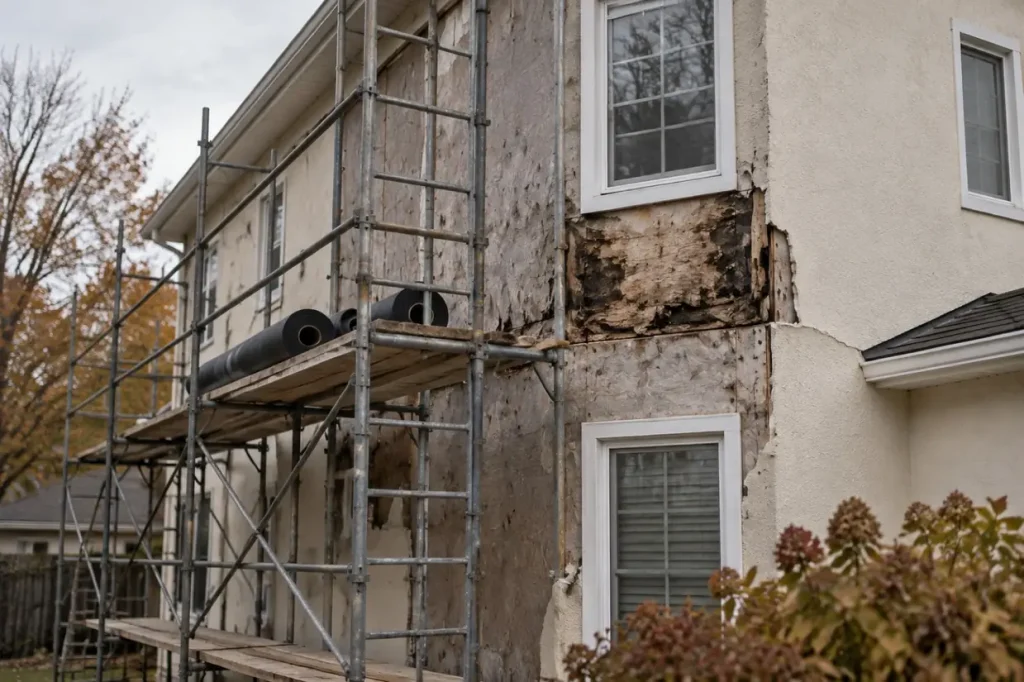
Stucco remediation means stripping stucco back to the sheathing, replacing wet or rotted wood, and rebuilding the wall with a drainage plane, flashing and a weep screed that meet IRC R703.7. It is the answer when probe readings find wet sheathing behind the stucco. Cracks over dry sheathing need repair, not remediation. Most leaks start at windows, roof-wall intersections, decks and the base of the wall.
Key takeaways
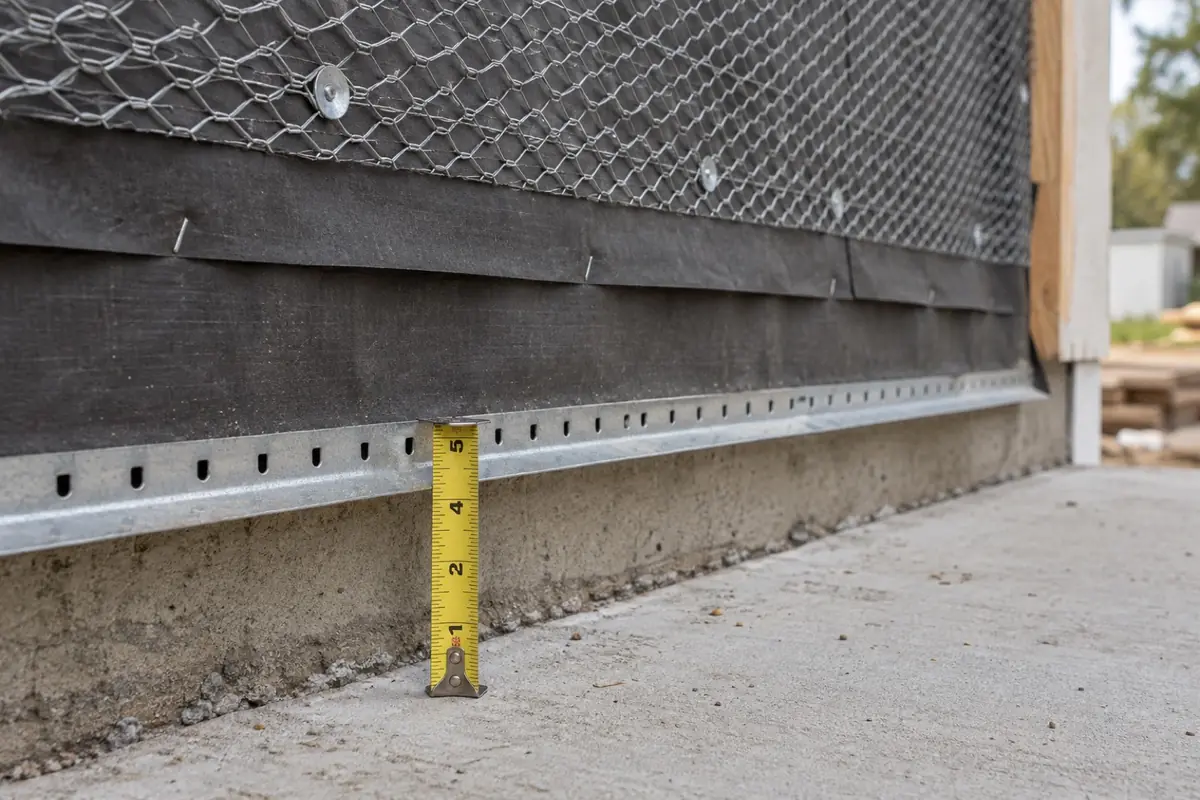
- The code sets the base of the wall: per the 2021 IRC chapter 7, the weep screed sits not less than 4 inches above earth or 2 inches above paved areas.
- Over wood sheathing in Moist zones, which include every county in Pennsylvania, New Jersey and Delaware, the 2021 IRC adds a drainage space of at least 3/16 inch or tested equivalent drainage.
- According to the City of Woodbury, Minnesota stucco position paper, 451 of 670 stucco homes standing in 1999 had failed and been repaired by February 2011, a rate of 67%.
- According to Structure Tech's published reading scale, 15% or less is normal and 20% or more is excessive moisture in sheathing behind stucco.
- Toll Brothers' fiscal 2016 Form 10-K reports an estimated water intrusion liability of $324.4 million, centred on stucco homes in Pennsylvania and Delaware.
On this page
What you are looking at: signs of stucco water damage
Stucco water damage hides. The wall can look perfect while the sheathing behind it rots: 6abc Action News reported in 2016 that many affected Delaware Valley homes showed no visible signs of leaks until the stucco was peeled back.
| What you see | What it usually means | Next step |
|---|---|---|
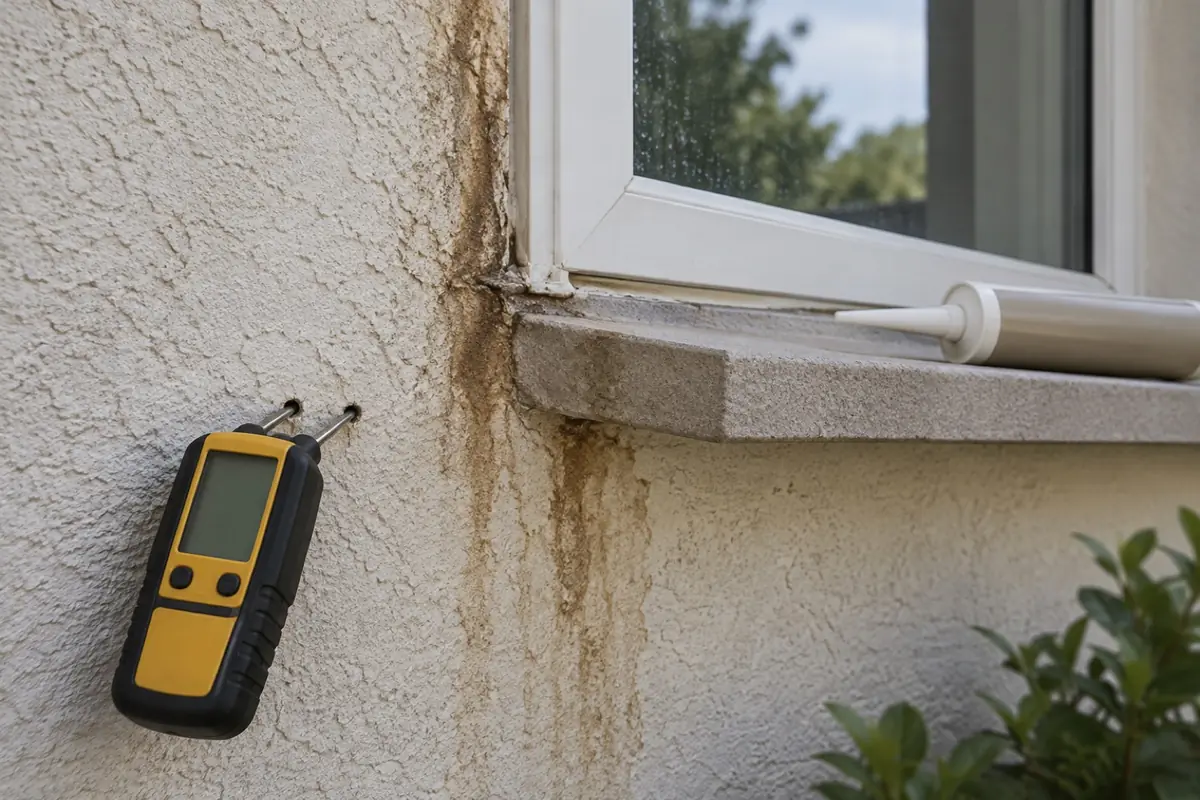
| Streaks or cracks below window corners | Window leaks, the leading cause Woodbury found | Probe test under that window |
| Stucco running into soil, mulch or a slab | No weep screed clearance; grade above the framing | Measure the screed height |
| Stains where a lower roof meets the wall | Missing kick-out flashing | Look for the kick-out |
| Rot or stains below a deck line | Improper deck flashing | Probe below the ledger |
| No visible sign at all | Common, per 6abc’s 2016 reporting | Invasive test if buying or selling |
Know which cladding you have. Traditional stucco is cement plaster over lath, installed under ASTM C926 and C1063 per the 2021 IRC chapter 7; the Philadelphia Inquirer notes that the late 1990s problems in the South involved EIFS, a different system. Water in a wall behind any cladding is covered on our water damage in walls page.
Why stucco homes leak
The best public record comes from a building department. The City of Woodbury, Minnesota stucco position paper found that window leaks, a lack of kick-out flashing, improper deck flashing and grade above the wood framing account for the majority of the damage, and that walls without windows or other openings sustained little or no damage.
| Failure point | Sign | Code requirement | Fix |
|---|---|---|---|
| Window and door openings | Staining or cracks below corners; wet readings under the sill | R703.4 and R703.4.1: corrosion-resistant flashing at openings, applied shingle-fashion | Remove stucco around the opening, reflash with the WRB lapped correctly, replace wet sheathing |
| Roof-wall intersection | Stain or rot where a lower eave meets a sidewall | R903.2.1: flashing to divert water where the eave of a sloped roof intersects a vertical sidewall | Install kick-out flashing; open and dry the wall below it |
| Base of the wall | Stucco buried in soil or mulch; wet bottom plate readings | R703.7.2.1: weep screed at or below the foundation plate line, 4 in above earth or 2 in above paving | Install a weep screed, regrade, replace the bottom course of sheathing |
| Water-resistive barrier | Wet readings across a whole wall, not one opening | R703.7.3: barrier over wood sheathing as the edition requires (see the table below) | Full strip and rebuild with the current barrier and drainage |
| Deck ledger and other attachments | Rot below a deck line or railing post | R703.4: flashing where porches, decks or stairs attach to the wall | Flash the ledger; remediate the wall section below |
What changed in 1999, and why it did not end the problem
| Detail | Old method (before May 1999) | New method (Woodbury, May 1999) |
|---|---|---|
| Building paper | One layer of type 15 felt was most common | Two layers grade D felt required by the state code |
| Windows | Flanged windows considered self-flashed; paper over the flanges | Flashing over all windows and doors; paper under side and bottom flanges, sealed |
| Top of wall | Paper stopped at the soffit line | Paper required to the top of the wall |
| Roof-wall junctions | Kick-out flashing mostly unknown | Kick-out flashing required where the roofline stops at a wall |
| Base of wall | Weep screeds not used | Weep screeds required |
The same paper reports repair permits for 56 homes built after 1999 under the new rules, and concludes that meeting the minimum prescriptive code is not enough.
What the code requires
Read the code itself, not a contractor’s summary. The 2021 IRC chapter 7 section R703.7.2.1 says a weep screed shall be provided at or below the foundation plate line on exterior stud walls, placed not less than 4 inches above the earth or 2 inches above paved areas, of a type that allows trapped water to drain to the exterior. The weather-resistant barrier laps its flange and the lath terminates on it.
Two layers of barrier, and what 2021 added
The often-quoted two layers rule is real but edition-specific. The 2015 IRC chapter 7 text required performance at least equivalent to two layers of Grade D paper over wood-based sheathing. The 2021 text splits by climate zone and, in Moist and Marine zones, adds a drainage requirement. The IRC climate zone table puts every county in Pennsylvania, New Jersey and Delaware in an A (moist) zone. Pennsylvania's 2018 residential code, as published on UpCodes, already carries the same climate split.
| Edition and section | Requirement over wood sheathing | Alternative path |
|---|---|---|
| 2015 IRC R703.7.3 | A water-resistive vapor-permeable barrier at least equivalent to two layers of Grade D paper, each layer a separate continuous plane, with flashing directed between the layers | Exception: one barrier equal to 60-minute Grade D, separated from the stucco by a nonwater-absorbing layer or drainage space |
| 2021 IRC R703.7.3.1, Dry (B) zones | Two layers of 10-minute Grade D paper or equivalent, installed independently, flashing directed between layers | Or 60-minute Grade D separated by foam sheathing, another non-absorbing layer or a designed drainage space |
| 2021 IRC R703.7.3.2, Moist (A) and Marine (C) zones | Everything in R703.7.3.1, plus a space or drainage material not less than 3/16 inch deep outside the barrier | Or drainage efficiency of at least 90 percent per ASTM E2273 or ASTM E2925 Annex A2 |
Which edition governs a rebuild is the local building department’s call; ask before the scope is priced.
Stucco moisture testing, and what the numbers mean
Inspectors describe three levels. Redfin lays them out as a Level 1 identification of the stucco system, a Level 2 non-invasive surface scan, and a Level 3 invasive inspection that drills small holes for moisture probes, which a buyer needs the seller’s written permission to run.
How an invasive stucco inspection is done
Structure Tech's published reading scale describes the method: two small holes about an inch apart at each test site, drilled with a 3/16 inch bit, probes insulated on their sides so they read the sheathing rather than the stucco or lath, and moisture estimated from conductivity. The Structure Tech testing page says holes go under most windows and at other likely entry points, then are sealed with injected, colour matched caulk.
| Reading (wood moisture) | Interpretation | Source |
|---|---|---|
| 15% or less | Normal in an exterior wall | Structure Tech published scale |
| 15% to 20% | Higher than normal; some leakage | Structure Tech published scale |
| 20% or more | Excessive moisture; possible structural damage | Structure Tech published scale |
| 20% or less | Air dry; a reasonable margin of safety | USDA FPL Wood Handbook |
| About 28% | Wood begins to rot | Structure Tech published scale |
| About 30% | Average fiber saturation; serious decay possible | USDA FPL Wood Handbook |
| About 40% | Saturated | Structure Tech published scale |
The USDA Forest Products Laboratory Wood Handbook explains the scale’s logic: serious decay needs wood above fiber saturation, and wood kept air dry will not decay.
Repair or remediation: the decision
Readings decide, not the look of the stucco. In order:
- Get readings first. Probe every opening before any patch. Why this differs from generic advice: a patch over wet sheathing hides the evidence.
- Map the wet readings. One high window is a spot job; several elevations point to the barrier. Why: Woodbury found damage concentrated at openings.
- Open one test area before pricing a full strip. Why: only exposed sheathing shows rot depth and the real barrier.
- Rebuild to the current code, not the original. Why: in Moist zones the 2021 text requires drainage the original wall never had.
- Retest after a wet season. Why: a remediated wall should read in the normal band; one that does not has an unfixed entry point.
The result is one of three scopes. Repair patches, caulks and recoats a wall whose sheathing reads dry. Spot or partial remediation cuts back around one opening or one wall, replaces sheathing, reflashes and ties new barrier into old shingle-fashion. Full remediation strips every elevation and rebuilds to R703.7.3, or re-clads: Choice Exteriors lists vinyl, fiber cement, shake and brick veneer as alternatives.
Opening the wall usually means interior work too: wet insulation and drywall, which our wet drywall guide covers, and moldy sheathing, removed under the mold remediation process. Framing left in place needs structural drying.
What stucco remediation costs
Published figures disagree by two orders of magnitude because of scope: low numbers price the stucco skin, high numbers the wall behind it. They are shown side by side, not averaged.
| Source | Published figure | Note |
|---|---|---|
| This Old House (updated 5 June 2026) | $8 to $50 per sq ft repair; water damage repair $30 to $50 per sq ft; average job $21,000 | Draws on Angi, Fixr, HomeAdvisor and Home Depot data |
| Bob Vila (updated 25 July 2023) | Water-damage repair $30 to $50 per sq ft; general repair $60 to $120 | Cites Angi and HomeAdvisor |
| Heiler Painting (PA, NJ, DE contractor, 2025) | Moderate damage with staining about $15 to $30 per sq ft; section replacement about $25 to $50+ | Extensive remediation priced per project |
| J&L Building Materials (8 July 2022) | Complete remediation $1,000 to $9,000 | Far below every other source |
| Choice Exteriors (Coatesville, PA, undated) | Removal $900 to $1,200, new stucco $8,000 to $11,100 | Excludes the repairs underneath |
| 6abc Action News (15 November 2016) | Remediation $100,000 to over $200,000 | Delaware Valley homes |
| City of Woodbury, MN (2003, revised 2009) | Many repairs $150,000 or more | Included structural and mold work |
On time, Choice Exteriors reports a typical project takes 10 to 18 days depending on home size and contractor schedule.
The stucco inspection in Pennsylvania, New Jersey and Delaware
Around Philadelphia, buyers commonly order a stucco inspection before purchase. The documented record behind that habit:
- The builder filings. Toll Brothers' fiscal 2016 Form 10-K reports rising water intrusion claims from 2014 by owners of stucco homes in Pennsylvania and Delaware communities built in fiscal 2003 to 2009, and attributes them to local construction practices of independent contractors in the region.
- The regulator. The Philadelphia Inquirer reported on 6 October 2016 that the Pennsylvania Office of Attorney General sued the Cutler Group under the state Unfair Trade Practices and Consumer Protection Law. Toll’s fiscal 2019 Form 10-K says the Attorney General began a review in March 2018 of its stucco homes built in Pennsylvania after 1 January 2005.
- The inspection gap. 6abc Action News reported in 2016 that stucco inspectors and remediators were not regulated, and quoted a consultant saying stucco and flashing details were not being inspected in Pennsylvania.
- New Jersey. No regulator or filing reviewed for this page documents a New Jersey stucco wave. The market overlaps: Heiler Painting, a regional contractor, lists South Jersey among its service areas.
None of this is unique to the Mid-Atlantic. Woodbury’s inspectors found in 1999 that 26 percent of the city’s stucco homes showed visible moisture damage from the street, according to the City of Woodbury, Minnesota stucco position paper.
Insurance language, and why claims are hard
Stucco leaks are slow. The ISO HO 00 03 sample form hosted by the Insurance Information Institute lists, among the perils it does not insure, wear and tear, deterioration, latent defect, dry rot, and mold, fungus or wet rot, with a narrow give-back for hidden mold caused by an accidental discharge from plumbing or heating systems. It also excludes faulty, inadequate or defective design, workmanship, construction, materials and maintenance.
This describes sample language, not your coverage. Read your own policy, ask your state insurance department, and talk to a qualified professional. More in our homeowners insurance and water damage guide.
For contractors
Stucco jobs are argued over long after they finish. Our water damage inspection guide covers moisture documentation generally; these items are specific to stucco.
| Document | Why it matters |
|---|---|
| Probe map with every reading, location and date | The scope and the price follow from it |
| Photos at each opening before and after stripping | Shows the failure point others will dispute |
| Sheathing replaced, by square foot and by wall | The line item most likely to grow mid-job |
| Climate zone and the R703.7.3 path chosen | Proves the rebuilt barrier meets the edition the permit uses |
| Weep screed height measured to grade and paving | R703.7.2.1 is a measurable pass or fail |
| Kick-out and window flashing photos before cladding | Hidden once the lath goes on |
Scope of this page. We describe code text, published scales and prices. Structural repairs need a qualified professional and a permit.
Questions people actually ask
What is stucco remediation?
It is the removal of stucco to expose the sheathing, replacement of wet or rotted wood, and a rebuild with a code compliant water-resistive barrier, drainage, flashing and weep screed, then new stucco or another siding. Repair, by contrast, fixes cracks and finish on a wall whose sheathing reads dry.
Does homeowners insurance cover stucco remediation?
Often not, but it depends on the policy. The ISO sample HO-3 form excludes wear and tear, deterioration, dry rot, most mold and wet rot, and faulty workmanship or construction, language that can reach slow stucco leaks. Check your own policy, your state insurance department and a qualified professional before assuming either way.
How long does stucco remediation take?
Choice Exteriors, a Pennsylvania contractor, says a typical project takes 10 to 18 days depending on home size and schedule. Jobs that uncover rotted framing take longer, because the wood must be replaced and dried before new barrier and stucco go on.
How much does it cost to redo stucco on an exterior?
Published figures range from about $8 to $50 per square foot for repair according to This Old House, to $100,000 to over $200,000 for full remediation of Delaware Valley homes as 6abc reported in 2016. The gap is scope: skin repairs against rebuilding the wall behind it.
What moisture reading is bad behind stucco?
According to Structure Tech’s published scale, 15% or less is normal, 15% to 20% means some leakage and 20% or more is excessive moisture with possible damage. According to the USDA Forest Products Laboratory, serious decay needs wood above fiber saturation, about 30% on average. No code sets a pass mark.
What is a stucco inspection?
Redfin describes three levels: identifying the stucco system, a non-invasive surface scan, and an invasive test that drills small holes so probes can read the sheathing. It calls invasive testing the most accurate, and says a buyer needs the seller’s written permission to do it.
Sources
- 2021 IRC chapter 7, 2015 IRC chapter 7, 2021 IRC section R903.2.1 and the IRC climate zone table (New Jersey editions), and Pennsylvania's 2018 residential code, via UpCodes. Retrieved 19 October 2026.
- City of Woodbury, Minnesota stucco position paper, Building Inspection Division, March 2003, revised 2009 and February 2011. Retrieved 19 October 2026.
- Structure Tech's published reading scale, Barry Eliason, 3 June 2014, and the Structure Tech testing page with current prices. Retrieved 19 October 2026.
- USDA Forest Products Laboratory Wood Handbook, chapter 14, USDA Forest Service, 2021. Retrieved 19 October 2026.
- Redfin, What Is a Stucco Inspection, 17 December 2025. Retrieved 19 October 2026.
- Toll Brothers' fiscal 2016 Form 10-K and fiscal 2019 Form 10-K, via SEC EDGAR. Retrieved 19 October 2026.
- Philadelphia Inquirer, Alan J. Heavens, 6 October 2016. Retrieved 19 October 2026.
- 6abc Action News, Nydia Han, 15 November 2016. Retrieved 19 October 2026.
- This Old House, updated 5 June 2026, and Bob Vila, updated 25 July 2023, stucco repair cost guides. Retrieved 19 October 2026.
- Heiler Painting, 2025; Choice Exteriors, undated; J&L Building Materials, 8 July 2022. Retrieved 19 October 2026.
- ISO HO 00 03 sample form hosted by the Insurance Information Institute, form HO 00 03 10 00, ISO 1999. Retrieved 19 October 2026.
- The FY2016 stucco figure is arithmetic on the filing’s amounts. Nothing here was tested or inspected by us. See our methodology and the water damage hub.
Code editions and local amendments vary. Confirm the adopted edition with the local building department before scoping a rebuild.